
Caribbean agave
Agave caribaeicola
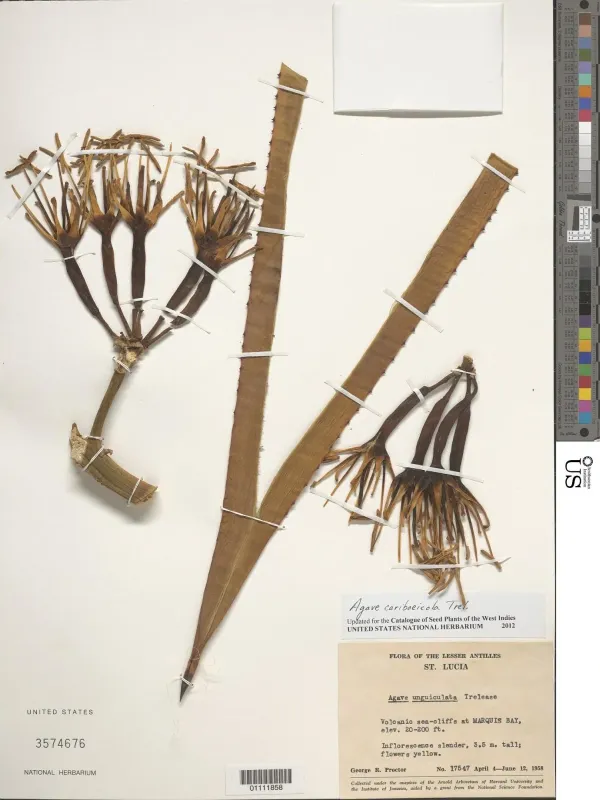
Description
Growing requirements
The Caribbean agave (Agave caribaeicola) is a perennial succulent belonging to the Asparagaceae family. This species is native to the Caribbean region, where it has evolved to thrive in arid and semi-arid environments.
The crop requires well-draining, coarse-textured soils, preferably sandy or rocky types. Good drainage is critical, as the roots are highly susceptible to rot when subjected to waterlogged conditions for extended periods.
Being a heliophilic plant, Caribbean agave demands full exposure to direct sunlight throughout the day. Sufficient solar radiation is essential for the efficient operation of its Crassulacean Acid Metabolism (CAM) photosynthetic cycle.
The ideal temperature for growth ranges between 22 °C and 32 °C. The species is highly tolerant to heat and low air humidity, making it an excellent candidate for drought-prone agricultural zones.
Correct spacing during planting is vital for long-term health. A density that allows for adequate airflow around the plant rosette helps minimize local humidity and prevents the development of fungal pathogens.
Yield
Caribbean agave is primarily cultivated for its high-quality, durable fibers found in the leaves. These fibers are recognized for their mechanical strength and resistance to environmental degradation.
The maturation period of the crop is extensive, typically taking several years from planting until the first harvest. However, once established, the plant acts as a perennial source of fibers for several decades.
Beyond fiber, the plant provides secondary products such as organic waste, which can be utilized for composting or bioenergy production, contributing to a circular agricultural model.
Yield metrics are calculated based on the weight of harvested leaves and the percentage of extractable fiber content. Proper nutrition, especially moderate potassium levels, enhances both growth rates and fiber quality.
The industry values the Caribbean agave for its ability to produce consistent volumes of industrial fiber even under minimal input conditions, making it an economically viable choice for tropical climates.
Main diseases and pests
Root-knot nematodes represent a significant threat to young plantations, as they hinder nutrient uptake and weaken the plant. Integrated pest management and crop rotation are the standard control methods.
Fungal infections, such as leaf spot, are a risk in regions with high nocturnal humidity. Improving air circulation around the plants is the most effective cultural practice for disease mitigation.
Weevils are among the most dangerous pests for Agave species, as they can bore into the plant's core. Regular field scouting and the removal of infested specimens are necessary to protect the plantation.
Bacterial soft rot can occur if the leaves are harvested using dull tools, leaving jagged edges that facilitate infection. Keeping harvest tools sharpened and sterilized is essential for phytosanitary safety.
Nutrient deficiencies, specifically regarding trace elements like manganese, can make plants more susceptible to environmental stress and opportunistic pathogens, requiring careful soil management.
Harvesting
The harvesting process involves removing the mature, outer leaves of the rosette while leaving the center intact. This allows the plant to continue producing biomass for future harvesting cycles.
Manual harvesting is common, performed with specialized knives designed to provide a clean cut near the base. This method is preferred to avoid damaging the inner growing point of the plant.
Post-harvest efficiency is crucial; leaves should be processed for fiber extraction as soon as possible after cutting to maintain the integrity of the fibers and prevent wilting.
Decortication is the core technical process, where mechanical scrapers remove the pulp from the fibers. The speed and quality of this process determine the final grade and market value of the fiber.
Once extracted, the fibers are cleaned and sun-dried until they reach an optimal moisture content. Proper drying ensures the fibers remain durable and ready for baling and commercial distribution.