
Valonia utricularis
Valonia utricularis
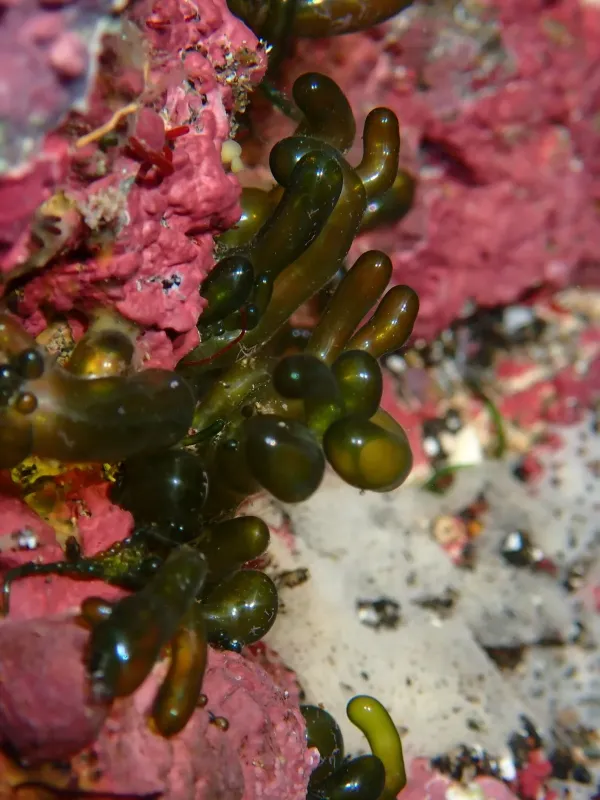
Description
Growing requirements
Valonia utricularis belongs to the Valoniaceae family and is recognized as a distinctive species of green marine algae. It is best known for its bubble-like appearance, where individual cells can expand to significant sizes, characterizing the unique morphology of this macroalga.
The natural habitat of this species includes tropical and temperate coastal regions. It predominantly attaches to rocky substrates, where it utilizes specialized rhizoids to secure its position against moderate wave action and tidal currents.
This species requires high water clarity and stable salinity levels to thrive. Proper light penetration is essential for photosynthesis, which is why the algae are typically found in shallow, sun-exposed waters where they can maximize their energy production.
Temperature is a critical factor for successful growth; the species prefers warm, stable maritime climates. Fluctuations in temperature can significantly affect its metabolic rate, with extreme cold potentially leading to the degeneration of the bubble-like thalli.
In controlled environments, such as laboratory studies or specialized aquaculture, maintaining a proper flow of oxygenated water is vital. Nutrient availability, particularly nitrogen and phosphorus, must be strictly monitored to support healthy growth cycles.
Yield
Valonia utricularis is not currently cultivated as a mainstream agricultural crop. Its value remains primarily scientific, as it serves as a model organism for studying cellular physiology, ion transport, and the mechanics of large-cell growth.
Future potential lies in the biochemical extraction of unique polysaccharides found in its cell walls. Researchers are investigating these compounds for possible applications in material science and biotechnology, though large-scale production remains a distant goal.
Yield in wild populations is limited by available surface area and ecological competition. In artificial setups, biomass production can be optimized by adjusting light intensity and the nutrient profile of the water, though this remains an experimental practice.
Harvesting is extremely delicate due to the fragility of the thallus. Traditional mechanical harvesting methods are unsuitable because they rupture the cells; therefore, any collection must be performed manually with extreme care to preserve the integrity of the organisms.
Despite the lack of commercial yield data, the species remains a subject of intense study due to its biological resilience and ability to colonize challenging maritime environments, providing a foundation for understanding marine biodiversity.
Main diseases and pests
The primary threat to Valonia utricularis populations is marine pollution. High levels of chemical runoff, heavy metals, and oil contamination can rapidly destroy local colonies and inhibit the regrowth of healthy tissue.
Grazing by marine herbivores, such as sea urchins and various gastropods, poses a significant threat to established colonies. These organisms can consume vast amounts of algae, leading to a rapid decline in population density.
Pathogenic outbreaks, often driven by bacteria or fungi, can lead to widespread necrosis of the bubbles. These diseases tend to spread quickly in stagnant water conditions where temperature and nutrient balances have been disrupted.
Competition from faster-growing filamentous algae is a constant pressure in the natural environment. These invasive competitors can easily overgrow Valonia, effectively blocking its access to sunlight and limiting nutrient uptake.
Ocean acidification presents a long-term threat to the structural integrity of the cell walls. Reduced pH levels make the algae more susceptible to mechanical tearing during storms or high-energy wave events, damaging the colony's capacity to regenerate.