
Tribolium echinatum
Tribolium echinatum
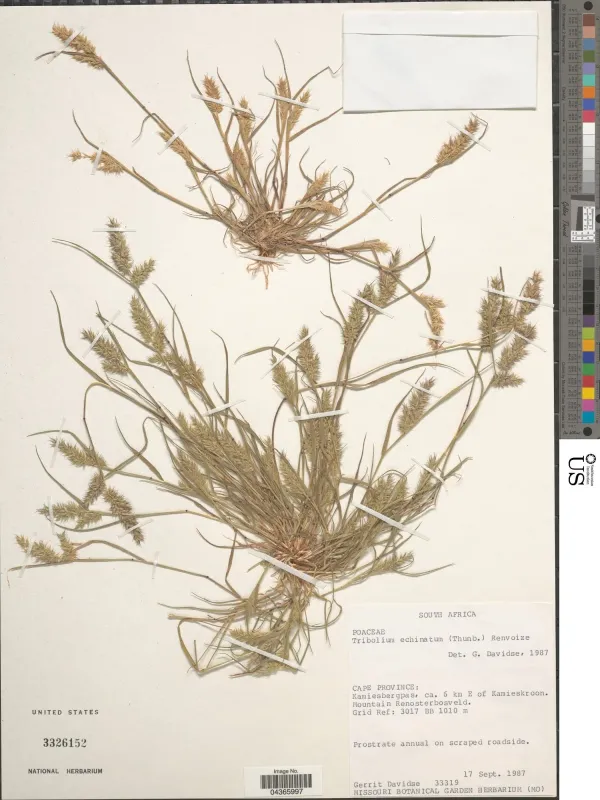
Description
Sowing dates
Tribolium echinatum, a member of the Poaceae family, requires specific timing for successful establishment. Planting is generally optimized for autumn, taking advantage of cooling soil temperatures and expected seasonal rainfall.
The seeds should be sown at a shallow depth of 1 to 2 centimeters. Because the seeds are quite small, precision seeding is necessary to ensure consistent germination and uniform emergence across the field.
Proper seedbed preparation is vital. The soil should be well-tilled and firm to allow for effective seed-to-soil contact, which is the primary driver for rapid moisture absorption by the embryo.
When sowing in large areas, farmers often use specialized grain drills calibrated for fine seeds to avoid burying them too deep, which is a common cause of poor emergence in this grass species.
Post-seeding management typically includes light rolling to compact the surface layer slightly, ensuring the moisture remains trapped near the seeds during the critical germination phase.
Growing requirements
This grass species thrives in well-lit, open environments. It shows a strong preference for well-drained soil types, particularly sandy loams that prevent water stagnation around the root crown.
In terms of climatic adaptation, it is well-suited to Mediterranean-like conditions, showing high resilience to periodic droughts once the root system has been properly established in the ground.
Soil pH levels should ideally be maintained within a neutral to slightly acidic range. Regular soil testing helps in managing nutrient availability, especially for potassium and phosphorus, which aid in root development.
The crop requires moderate fertilization. Over-application of nitrogen should be avoided to prevent excessive vegetative growth that could result in lodging or increased susceptibility to fungal diseases.
Adequate spacing between rows is recommended if the crop is intended for high-quality seed production, as this allows for better aeration and reduces the humidity levels within the canopy.
Main diseases and pests
Fungal infections are the most common biological threat. High humidity levels during the growth cycle can trigger outbreaks of rust or powdery mildew, which can significantly damage leaf tissue.
Insects, particularly aphids and various soil-dwelling beetles, pose risks during the early stages of plant development. Integrated pest management (IPM) strategies are highly encouraged to control these threats.
Weed management remains the most challenging aspect of cultivation. Competing weeds can easily outgrow young grass, robbing it of essential sunlight and nutrients, leading to reduced yield.
Root-rot pathogens can accumulate if the same fields are used for the same grass family consecutively. Implementing a robust crop rotation plan is essential to mitigate soil-borne disease risks.
Early detection of pests via field scouting is the best defense. Farmers should be prepared to apply targeted treatments if infestation thresholds are reached, always prioritizing environmental safety.