
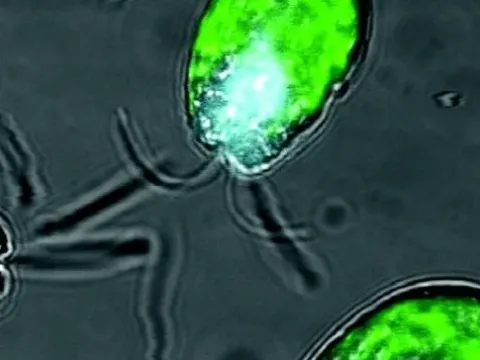
Tetraselmis
Tetraselmis
Tetraselmis cultivation begins with the inoculation of a pure culture into a sterile nutrient-rich medium to initiate rapid exponential growth.
What the section contains

Tetraselmis
The process usually starts in small-scale laboratory flasks, which are then scaled up to larger photobioreactors or outdoor open ponds.
Managing the initial cell density is vital to establish a strong population and prevent contamination by undesirable microorganisms or wild algae.
Continuous culture systems allow for the daily harvesting of a fraction of the volume, which is then replaced by fresh, nutrient-supplemented seawater.
Successful inoculation depends on maintaining strict aseptic protocols to ensure the purity and genetic stability of the chosen microalgae strain.
Tetraselmis is highly adaptable and can thrive across a broad range of salinity, making it robust for various marine aquaculture environments.
The ideal temperature for rapid cell division is between 18 and 25 degrees Celsius, requiring effective cooling or heating systems for stability.
High light intensity is essential for photosynthesis; thus, artificial full-spectrum lighting is commonly used to maintain consistent growth rates.
The medium must be enriched with macro-nutrients like nitrogen and phosphorus, as well as essential trace elements and vitamins for optimal health.
Constant agitation via vigorous aeration is required to keep cells suspended and ensure efficient carbon dioxide exchange throughout the medium.
Productivity is measured by cell concentration, often reaching millions of cells per milliliter in well-managed high-density production units.
Yield efficiency is determined by the biomass accumulation rate, which is a key metric for calculating the economic viability of the farm.
Regular monitoring of cell density allows operators to harvest at the peak of the growth phase, ensuring maximum nutritional content for aquaculture feed.
Optimized conditions lead to high-density yields that can be maintained consistently throughout the production cycle with minimal strain degradation.
The final yield provides a rich source of proteins and lipids, making it a highly valuable feed source for larval stages of shrimp and shellfish.
Protozoan contamination represents a major threat, as these organisms can consume the algae population and collapse the culture rapidly.
The invasion of competing algae species often results in the displacement of Tetraselmis, leading to a decline in overall feed quality.
Bacterial blooms, often triggered by poor water quality or inadequate sterilization, can cause total loss of the batch within hours.
Environmental stress, such as extreme pH fluctuations or light inhibition, can damage cell walls and lead to mass lysing of the microalgal culture.
Effective biosecurity and regular monitoring are the primary defense mechanisms against these biological and chemical risks in a production setting.
Harvesting is typically achieved through centrifugation, which effectively separates the algae cells from the culture medium to create a dense paste.
Alternatively, flocculation methods are employed to settle the cells at the bottom, allowing for easy collection of the concentrated biomass.
Once collected, the paste should be processed or utilized immediately, or stored in cold chains to preserve its fragile lipid and vitamin content.
For feeding purposes, the concentrated algae is diluted in seawater to match the required density for larval nursery tanks.
Quality control during harvest involves testing for purity and nutritional concentration to ensure the final product meets aquaculture standards.