
Babingtonia virgata
Babingtonia virgata (J. R. Forst. & G. Forst.) F. Muell.
Description
Growing requirements
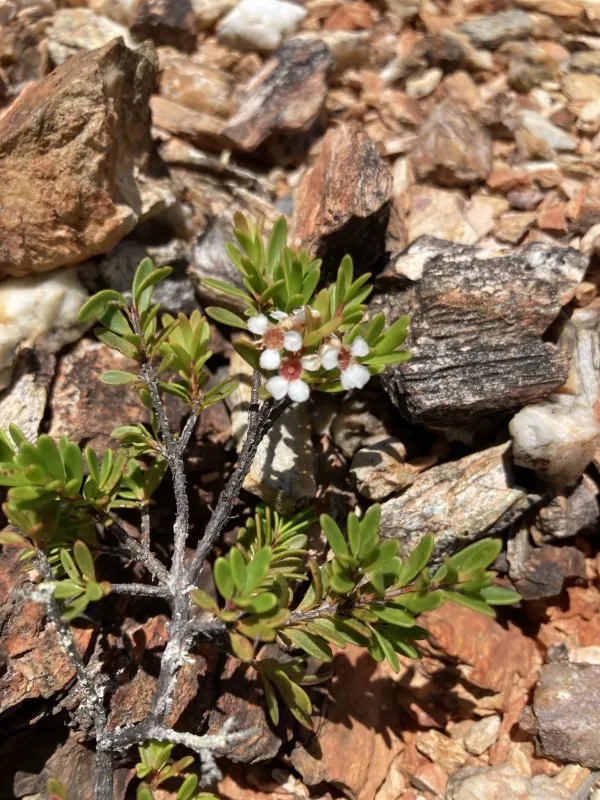
Babingtonia virgata is a perennial evergreen shrub belonging to the Myrtaceae family. Native to Australia and the South Pacific, it is known for its delicate foliage and abundant, small, star-shaped flowers that appear during the warmer months.
Cultivation of this species requires a location with full sun exposure. In regions with intense solar radiation, providing partial shade during the afternoon helps to prevent the scorching of the leaves and premature moisture loss.
The soil should be well-draining and slightly acidic. It thrives in loamy or sandy substrates, often benefiting from the addition of organic matter to improve soil structure while ensuring that water does not accumulate around the root collar.
Regarding moisture, this plant prefers consistent humidity without being waterlogged. During the active growth phase, it should be watered whenever the top layer of the soil feels dry to the touch, while irrigation frequency must be minimized during dormancy.
Environmental conditions must be kept stable. As a subtropical plant, it is not frost-tolerant, meaning it should be kept in protected conditions or indoors if the temperature drops significantly below 10 degrees Celsius.
Main diseases and pests
Root rot is the most serious threat to the vitality of Babingtonia virgata. It is usually caused by excessive watering or an poorly drained substrate, which deprives the roots of necessary oxygen and invites fungal pathogens.
Pest issues often involve sap-sucking insects. Scale insects are particularly problematic as they form hard, protective covers on stems, making them difficult to detect until the plant starts showing signs of stress like leaf yellowing.
Mealybugs are another concern, often clustering in the leaf axils or on the underside of branches. Their presence can lead to the formation of sooty mold, which impairs the plant's ability to perform photosynthesis.
Spider mites represent a risk in dry, low-humidity environments. Their presence is marked by fine webbing and a stippled appearance on the leaves, requiring prompt action to increase humidity levels or apply appropriate treatments.
Pruning is an essential part of disease prevention. By thinning out the canopy, you improve air circulation, which significantly reduces the likelihood of fungal diseases such as leaf spots or powdery mildew.