
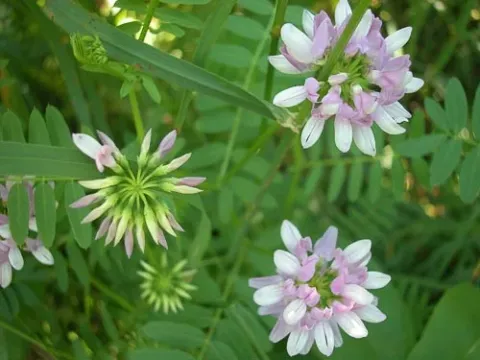
Crownvetch
Securigera
Crownvetch, scientifically known as Securigera varia, is a perennial legume highly valued for its ability to stabilize soil and improve fertility. Sowing is typically performed in early spring or late autumn in temperate climate zones.
What the section contains

Crownvetch
Soil preparation requires deep plowing followed by seedbed compaction to ensure uniform emergence. The seeds are usually sown at a shallow depth of 1.5 to 2.5 centimeters to avoid desiccation of the germinating embryos.
When establishing a stand, it is essential to ensure proper seed-to-soil contact. Seeding rates vary based on the intended purpose; higher densities are required for forage production, while lower rates are sufficient for erosion control projects.
Seedlings develop slowly during the first year, which necessitates vigilant weed management. The plant invests heavily in root development initially, meaning that high biomass production only begins in the second growing season.
Germination is most successful when soil temperatures range between 10 and 12 degrees Celsius. Timely planting ensures the root system becomes well-established before the onset of stressful summer heat waves.
Crownvetch is highly adaptable to various soil types but thrives in well-drained, alkaline or calcareous soils. It is remarkably drought-tolerant once established, thanks to its extensive and deep taproot system.
As a light-loving species, it requires open, full-sun exposure to reach its maximum blooming potential and biomass yield. It shows excellent cold hardiness, surviving harsh winters in various temperate regions across the globe.
The crop does not demand high soil fertility and performs well on marginal, stony, or disturbed lands. It forms a beneficial symbiosis with rhizobia bacteria, allowing it to fix atmospheric nitrogen and enrich the soil.
An optimal soil pH for this plant ranges from slightly acidic to slightly alkaline. It does not tolerate waterlogging or poorly drained conditions, which can lead to rapid root rot and stand depletion.
Due to its aggressive growth habit once established, it is a superior choice for preventing slope erosion and landslides. Its ability to grow in tough conditions makes it a favorite for land reclamation projects.
The yield of Crownvetch depends on the age of the stand and seasonal rainfall patterns. Under optimal conditions, it can provide up to two high-quality forage cuttings per growing season.
It is prized as a nutritious forage source, though palatability can decrease if harvested too late due to stem lignification. With proper management, dry matter yields can be quite significant on a per-hectare basis.
Integrating this crop into a long-term rotation strategy significantly improves soil structure and nutrient availability for subsequent crops. A single planting can remain productive and dense for five to eight years.
In grazing scenarios, it provides a consistent feed source throughout the summer months. It is important to avoid overgrazing to ensure that the plant retains enough reserves in the roots for overwintering and rapid spring regrowth.
Peak biomass productivity is typically achieved by the third year, once the mat-forming root system has fully occupied the available space in the upper soil horizons.
The primary biological threats to Crownvetch include fungal infections like anthracnose and leaf spots, particularly in humid conditions. Maintaining good air circulation within the stand is a critical preventative measure.
Insect pests, such as clover root curculios, can cause damage to the root system, indirectly affecting nitrogen fixation efficiency. Aphid infestations may also occur during the rapid growth phase of the succulent shoots.
When pest thresholds are exceeded, the application of targeted insecticides may be necessary. However, most agronomic strategies focus on healthy stand management and crop rotation to minimize these issues.
Viral diseases, though less common, can cause significant stunting and leaf distortion. Infected patches should be removed promptly to prevent the spread of the virus across the entire planting area.
Effective disease management relies on using certified, high-quality seed and avoiding excessive nitrogen fertilization, which can create a lush, micro-humid environment favorable for fungal pathogens.
Harvesting for forage is best conducted during the early bloom stage, as this represents the peak nutritional value and protein content. Delaying the harvest results in harder stems and a significant decline in quality.
When baling as hay, the material must be dried quickly to minimize leaf loss, which contains the highest nutritional density. Using tedders is highly recommended to ensure uniform drying across the entire swath.
For seed production, harvesting should occur when the majority of the pods have darkened but before they begin to shatter. Mechanical harvesting is most efficient during early morning hours when atmospheric humidity is higher.
Seeds must be cleaned and dried to stable moisture levels immediately post-harvest to prevent heating and loss of viability. Proper storage in cool, dry conditions is essential for maintaining germination rates for future planting.
Long-term maintenance of these stands may require occasional fertilization or over-seeding to rejuvenate the plant population and ensure high productivity over time.