
Scenedesmus quadricauda
Scenedesmus quadricauda (Turp.) Breb
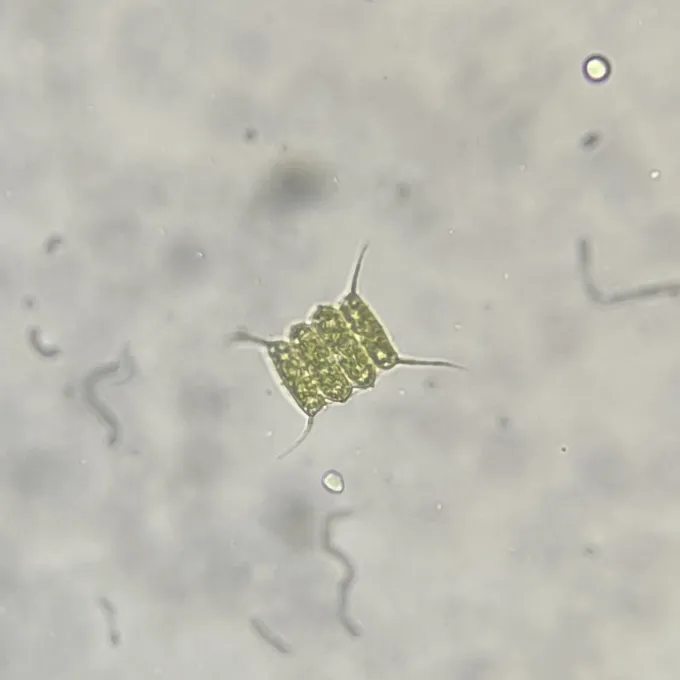
Description
Sowing dates
Scenedesmus quadricauda is a green microalga belonging to the Scenedesmus genus, widely recognized in biotechnology for its rapid biomass accumulation and high protein content.
In industrial cultivation, seeding involves inoculating a sterilized nutrient medium with a dense, actively growing strain of the algae to ensure a rapid population explosion.
The inoculum must be free from contaminants and maintained in an exponential growth phase to guarantee high productivity in the larger growth vessels.
Effective seeding strategies often utilize batch or semi-continuous methods, where a portion of the culture is harvested and replaced with fresh growth media.
Proper aeration during the initial phase is crucial for establishing a healthy colony, providing the necessary movement to distribute light and carbon dioxide uniformly.
Growing requirements
Scenedesmus quadricauda is highly versatile, but achieving maximum productivity requires strict control over environmental parameters including light, temperature, and pH.
The optimal temperature for growth ranges between 20°C and 30°C, which allows for efficient metabolic processes and cellular division within the coenobium.
Nutrient supply must include essential minerals such as nitrogen, phosphorus, and potassium, usually provided via specialized mineral salts or fertilizer-enriched water.
Light intensity is the limiting factor in many systems, requiring careful management of water depth and cell density to avoid self-shading effects.
Maintaining a stable pH (around 8.0) is essential to prevent the precipitation of minerals and to ensure that inorganic carbon remains accessible to the algae.
Yield
The yield of Scenedesmus quadricauda is exceptionally high, with the capacity to produce significant amounts of biomass in a relatively short period.
Productivity levels are often measured in grams per liter per day or tons per hectare, showcasing the potential of microalgae as a primary source of sustainable protein.
Rich in lipids, proteins, and essential pigments, the biomass serves as a valuable ingredient in livestock feeds and commercial aquaculture operations.
Continuous monitoring of culture density helps determine the optimal harvest timing, maximizing the final output of valuable cellular components.
Scaling up production while maintaining high yields requires precise automation of media replenishment and waste product removal from the growth system.
Main diseases and pests
Biological threats to Scenedesmus cultures include parasitic fungi and bacterial infections that can cause widespread cell death in closed bioreactors.
Zooplankton grazers, particularly rotifers and daphnia, are notorious for consuming vast amounts of algae, leading to sudden population collapses if they invade the system.
Viruses specific to green algae can also significantly impact large-scale production, necessitating robust biosecurity measures and frequent culture replacement.
Competition from unwanted faster-growing algal strains can shift the culture composition, often resulting in lower-quality final biomass.
Preventative strategies focus on maintaining strict hygiene, ultraviolet filtration of water, and regular microscopic testing to detect threats early.
Harvesting
Harvesting techniques vary depending on the scale and economic focus, ranging from mechanical filtration to chemical flocculation and centrifugation.
The process involves isolating the biomass from the growth medium, resulting in a dense algal slurry ready for further processing or immediate use.
After concentration, the biomass is typically dried using spray drying or lyophilization to preserve the nutritional value and shelf life of the product.
Automated harvesting systems significantly reduce operating costs and increase the overall efficiency of large-scale algae farms.
Proper handling during harvest is critical to prevent degradation of sensitive fatty acids and pigments, ensuring high-quality output for industrial markets.