
Finnmark willow
Salix finnmarchica
Description
Growing requirements
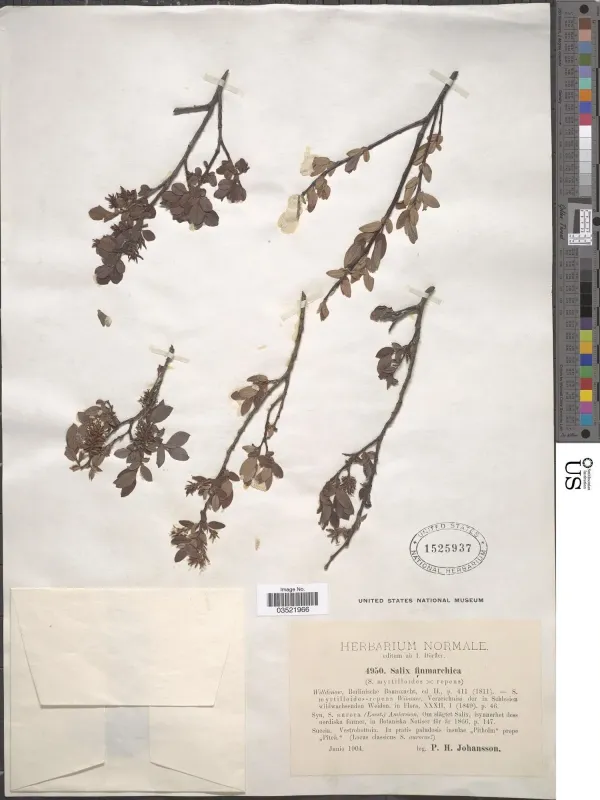
The Finnmark willow (Salix finnmarchica) belongs to the Salicaceae family. It is a resilient shrub species adapted to survive in harsh northern climates, demonstrating remarkable frost resistance and durability.
Its natural origin is linked to the subarctic regions of Northern Europe. The plant is well-adapted to the specific environmental pressures of its native habitat, including strong winds and relatively short, cool growing seasons.
Regarding soil requirements, this willow thrives in moist, organic-rich substrates. It is particularly well-suited for planting in wetlands or along watercourses, where its root system can thrive in saturated, cool soils.
Agrotechnical management is relatively simple once the plant is established. Annual pruning helps to maintain the desired shape and density of the shrub, especially when used in ornamental landscape design.
The economic and practical value of Salix finnmarchica lies in soil stabilization and erosion control. Its ability to colonize difficult terrains makes it a valuable species for ecological restoration and urban greening projects in cold climates.
Main diseases and pests
Common plant pathogens include rusts and leaf spots, which are prevalent in high-humidity conditions. Proper aeration and site selection are the primary cultural methods to prevent the spread of fungal diseases.
Insect pests, such as willow leaf beetles and aphids, may occasionally infest the plants. Management strategies focus on integrated pest control to protect the canopy and ensure the healthy development of the shoots throughout the season.