
Taraxacum kok-saghyz
Taraxacum kok-saghyz L. E. Rodin
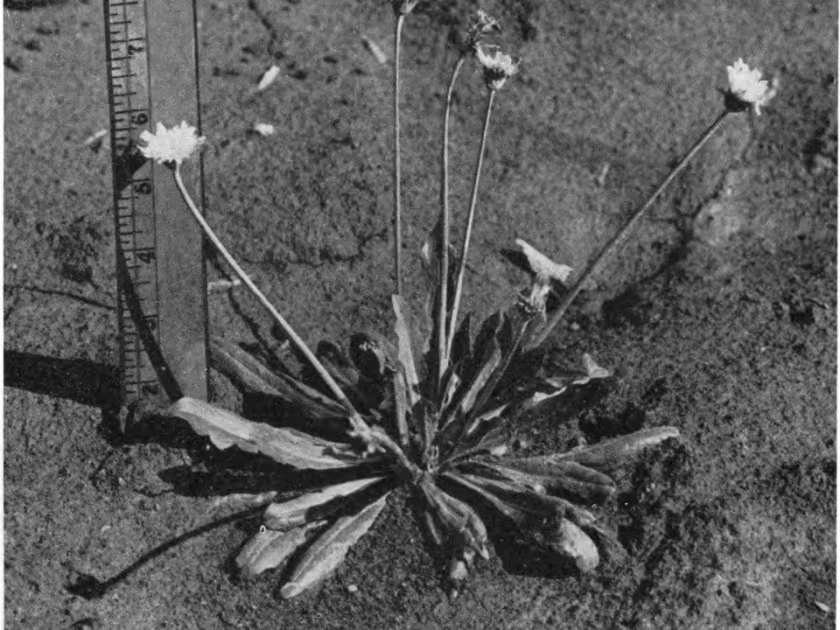
Description
Sowing dates
The optimal time for sowing kok-saghyz is early spring, as soon as the soil temperature reaches 5–8 degrees Celsius. The plant is characterized by slow initial growth, so early sowing allows for the effective use of soil moisture for seed germination.
Late autumn sowing is also possible and often practiced to achieve more uniform emergence in the spring. Seeds require quality incorporation into loose soil at a depth of no more than 0.5–1 cm to ensure optimal contact with the substrate.
The seeding rate should account for the relatively low field germination rate of seeds in the first year of cultivation. It is recommended to use precision seeders to avoid overcrowding and to facilitate subsequent maintenance of the young crops.
A crucial factor for success is timely site preparation, which includes deep plowing and thorough cleaning of perennial weeds. Kok-saghyz is very sensitive to weed competition, especially during the rosette leaf formation stage.
After mass emergence, the first thinning should be carried out to leave optimal spacing between plants in the row. This promotes better development of the root system and the accumulation of rubber in the plant tissues.
Growing requirements
Taraxacum kok-saghyz is a perennial herbaceous plant of the Asteraceae family, native to the high-mountain regions of the Tian Shan. In the wild, it is found on moist saline meadows, which determines its high resistance to challenging soil conditions.
The crop prefers light sandy loam or loamy soils with good aeration. Excessive waterlogging or heavy clay soils contribute to the rotting of the taproot, which negatively affects the yield of rubber raw material.
The plant is quite demanding in terms of light, so cultivation plots must be open and well-warmed by the sun. In conditions of insufficient sunlight, the accumulation of latex in the roots slows down significantly, making cultivation economically unviable.
For kok-saghyz, moderate continental climatic conditions with a clear separation of active growing periods and winter dormancy are optimal. It is capable of withstanding significant temperature fluctuations typical of its natural foothills habitat.
An important biological feature is the plant's ability to form a powerful taproot that penetrates deep into the soil. To ensure normal root system development, it is necessary to exclude the presence of a dense plow pan at a depth of up to 40–50 cm.
Yield
The primary economic use of kok-saghyz is for the production of natural rubber, which is contained in the milky sap of the roots. The latex of this plant is physically and chemically similar to Hevea rubber, making it a strategically important material for the tire industry.
Crop yield depends on the age of the plant: the maximum concentration of rubber is usually achieved in the second year of life. In industrial settings, annual or biennial cultivation is practiced, depending on planting density and the fertilizers applied.
In addition to rubber, the plant contains inulin, a valuable polysaccharide that can be used in the food and pharmaceutical industries. This expands the possibilities for complex biomass processing, increasing the overall profitability of production.
To increase the yield of the finished product, it is necessary to ensure balanced mineral nutrition, with an emphasis on potassium fertilizers that promote better root development. Nitrogen fertilizers are applied cautiously to avoid stimulating excessive growth of the aerial part at the expense of the roots.
The yield of kok-saghyz green mass is relatively small, but it can be used as a secondary product or a component of feed mixtures. However, the main value of the crop is concentrated specifically in the underground part of the plant.
Main diseases and pests
The greatest threat to young crops is posed by diseases typical of the Asteraceae family, such as powdery mildew and various types of root neck rot. These become active under conditions of high humidity and dense planting.
Among pests, the greatest damage is caused by insects that attack the root system, in particular larvae of wireworms and white grubs. Damage to the roots not only reduces the mass of the raw material but also contributes to secondary infection by pathogenic fungi.
Aphids may infest the leaf rosette during hot periods, sucking sap and reducing the plant's overall photosynthetic activity. This leads to the weakening of the crop and a slowdown in the rate of latex accumulation in the roots.
Control measures include crop rotation using cereal crops that are not hosts to specific dandelion pests. Timely weed control is also essential, as weeds often act as reservoirs for infections and pests.
Chemical protection should be used strictly according to need, taking into account the safety of the rubber raw material. The use of disease-resistant varieties is the priority protection method within modern agronomy.
Harvesting
Harvesting of kok-saghyz is carried out mechanically using special harvesters capable of extracting deep taproots from the soil. The harvest time is chosen during the period of maximum rubber accumulation, most often in the autumn of the second year of life.
Before harvesting begins, the aerial part (leaf rosette) is usually mowed to facilitate the process of digging up the roots and cleaning them of soil particles. Leftover plant residues do not pose a threat, as the crop is a herbaceous perennial.
Once extracted, the roots require rapid primary processing to prevent spoilage, as the high level of moisture and organic matter makes them susceptible to mold. Cleaning and drying are key stages in maintaining the quality of the raw material.
It is important to minimize root losses during mechanical digging, as the thin peripheral roots also contain a significant amount of latex. The use of vibrating conveyors allows for the effective separation of raw material from soil clumps.
After harvesting, the raw material undergoes grinding and subsequent extraction of rubber at processing plants. Modern technologies allow this process to be carried out with a high yield coefficient, ensuring the purity of the final product.