
Psylliostachys suworowii
Psylliostachys suworowii (Regel) Roshkova
Description
Sowing dates
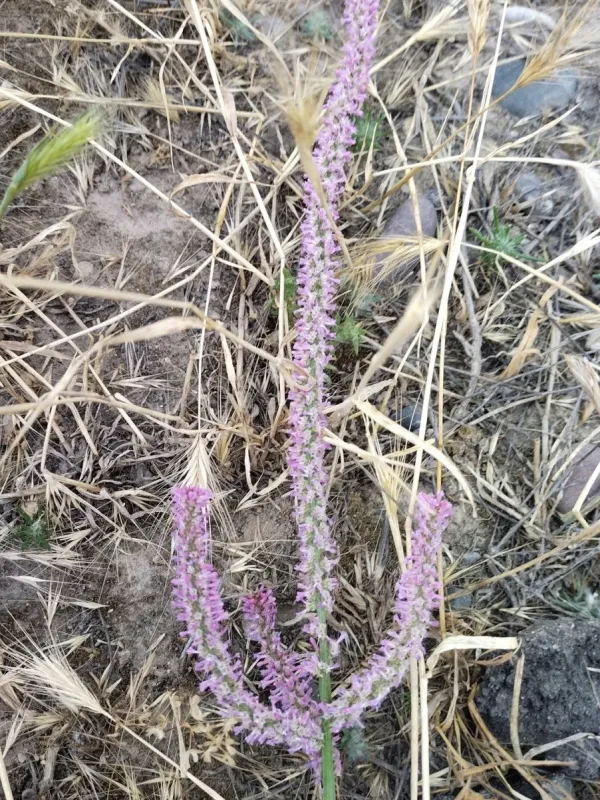
Psylliostachys suworowii is a botanical species belonging to the Plumbaginaceae family, native to the arid environments of Central Asia.
As an ephemeral plant, the sowing period is restricted to early spring, aiming to utilize residual soil moisture before the onset of high summer temperatures.
Seeds should be sown at a shallow depth of 1-2 cm, as they require sufficient sunlight to initiate the germination process effectively.
Maintaining a steady temperature range of 10-15 degrees Celsius is crucial during the emergence phase to ensure uniform development of the seedlings.
The spacing between rows should be at least 30 cm to allow for adequate airflow and to prevent competition between plants during the rapid growth phase.
Growing requirements
This species is highly adapted to sandy or loamy soils with low organic matter content, characteristic of its native desert habitat.
A key agronomic feature of Psylliostachys suworowii is its tolerance to soil salinity, classifying it as a potential candidate for salt-affected land reclamation.
The plant requires full sun exposure throughout its entire life cycle, as any degree of shading significantly negatively impacts its growth and floral production.
Excellent drainage is a non-negotiable requirement, as the root system is highly sensitive to waterlogging, which often leads to rapid decay.
While the plant is extremely drought-tolerant, supplemental irrigation during the seedling stage can significantly improve final biomass and seed yield.
Main diseases and pests
Under natural conditions, the plant is relatively robust, but in cultivation, it can be susceptible to fungal pathogens if soil moisture is not managed.
The primary threats include root rot diseases caused by poor drainage and excessive irrigation, which are the most common reasons for crop loss.
Occasional infestations of sucking insects can occur, although the plant's hairy, drought-adapted leaves provide some level of natural physical defense.
Proper field rotation and soil sterilization techniques are recommended to minimize the accumulation of soil-borne pathogens in intensive cropping systems.
Early detection and immediate removal of affected individuals are the best practices for preventing the spread of diseases within the plant population.
Harvesting
Harvesting should be timed precisely with the maturation of the inflorescences, as the seeds are prone to spontaneous shattering once fully ripened.
The harvest is typically performed once the stalks show distinct browning, indicating that the seeds have reached physiological maturity.
Mechanical harvesting must be handled with care to avoid damage to the fragile stems and to ensure minimal loss of the tiny, lightweight seeds.
Post-harvest drying in a well-ventilated space is essential to reduce moisture content and ensure long-term viability of the collected germplasm.
Final cleaning of the seeds using specialized air-flow separators is necessary to remove chaff and organic debris effectively before storage.