
Peucephyllum schottii
Peucephyllum schottii
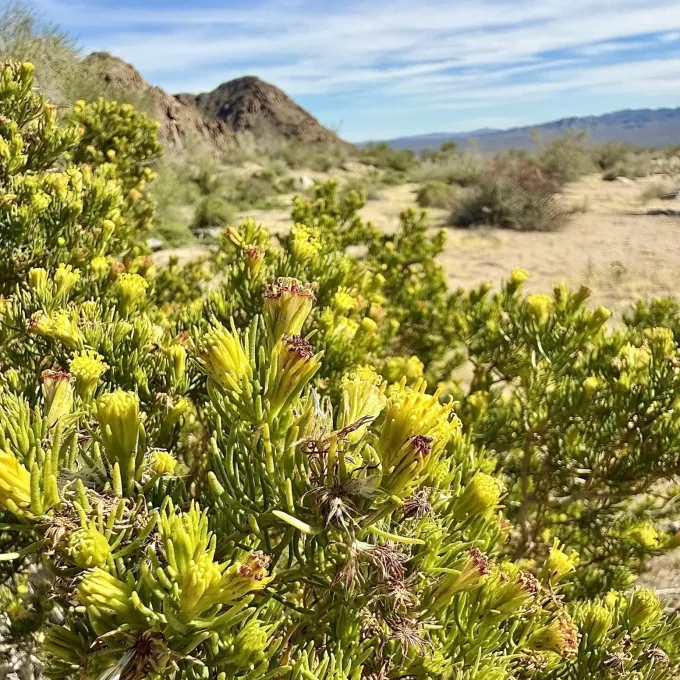
Description
Growing requirements
Peucephyllum schottii, commonly known as desert pine, belongs to the Asteraceae family. Despite its common name and the needle-like appearance of its foliage, it is not related to conifers but is a true flowering shrub.
The plant is native to the arid desert regions of the Southwestern United States and Northwestern Mexico. It thrives in extreme heat and rocky environments, making it a masterpiece of adaptation to desert survival.
Cultivation requires exceptionally well-drained soils, typically gravelly or sandy substrates. It is essential to ensure that the root system is never waterlogged, as the species is highly susceptible to root rot if moisture levels remain high for extended periods.
Full sunlight is a critical requirement for this species. It needs intense light to maintain its compact growth form and resinous, aromatic foliage. It is highly alkaline-tolerant and requires almost no irrigation once established.
In landscaping, it is used for xeriscaping, providing a unique texture that mimics evergreen shrubs in arid environments where traditional landscaping would require unsustainable water inputs.
Main diseases and pests
Peucephyllum schottii exhibits remarkable resistance to pests due to its resinous and aromatic chemical composition, which acts as a natural deterrent against many herbivorous insects.
The primary threat to this plant is cultural, specifically over-irrigation. Poor drainage or excessively frequent watering will inevitably lead to fungal pathogens attacking the root system and crown, which are almost impossible to treat once established.
In humid climates or enclosed greenhouse environments, stagnant air can lead to powdery mildew. Ensuring proper air circulation is the best preventive measure to maintain the health of the plant's foliage.
While pests are rarely a concern, the plant should be inspected periodically for sap-sucking insects if it is planted in an environment outside its native range where predator populations might be different.
Minimalist maintenance is the hallmark of this crop. By strictly adhering to its need for dry, well-drained conditions, the grower can avoid almost all common health issues associated with this species.