
Dulse
Palmaria palmata
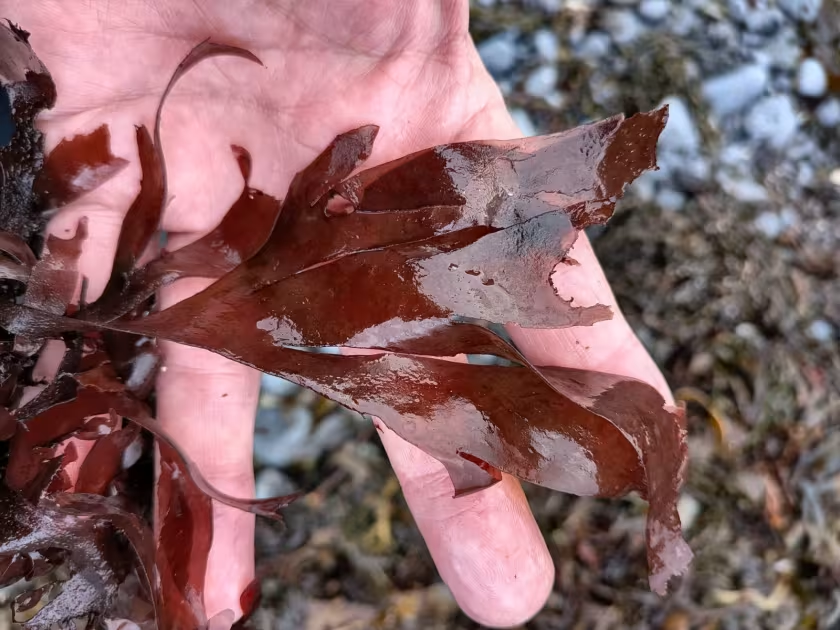
Description
Sowing dates
Dulse (Palmaria palmata) propagation in aquaculture primarily relies on spore recruitment onto artificial substrates. The process starts by deploying ropes or nets in areas with high natural spore concentrations during the release season, which typically occurs in spring and autumn.
Once the spores have successfully attached to the cultivation substrate, the seeded lines are relocated to protected marine sites or land-based tank systems. This stage requires careful timing to ensure environmental conditions favor rapid initial attachment and early development of the blades.
Vegetative propagation is an alternative method used in controlled environments, where mature thalli are cut into fragments and encouraged to reattach to a new base. This technique is highly efficient for maintaining specific high-quality strains within indoor tank operations.
Successful colonization of the substrate depends on maintaining optimal temperatures, ideally between 5 and 12 degrees Celsius. During this critical establishment phase, minimizing physical disturbance to the substrate is essential to ensure a high success rate of spore recruitment.
The density of the substrate placement is adjusted based on nutrient availability and water flow. Overcrowding the lines can lead to reduced nutrient uptake for individual plants, therefore careful spacing is maintained to optimize the development of each Dulse blade.
Growing requirements
Dulse is a cold-water species, thriving in environments where water temperatures stay below 15 degrees Celsius. It is highly sensitive to heat stress, which can lead to rapid blade degradation and reduced photosynthetic activity, making site selection a priority.
The salinity of the water must be strictly monitored and maintained within the 25–35 PSU range. Fluctuations in salinity, particularly rapid drops due to freshwater runoff, can cause significant physiological stress, often resulting in the loss of pigment and cell tissue integrity.
High light availability is vital, although Dulse is adapted to survive in lower light zones. In commercial farming, clear, nutrient-rich water is preferred to ensure that enough photosynthetically active radiation reaches the seaweed blades, promoting faster growth rates.
Continuous water movement is essential for Dulse to efficiently absorb dissolved minerals such as nitrogen and phosphorus. In stagnant water, a boundary layer of depleted nutrients can form around the thallus, effectively halting growth and increasing the risk of pathogen buildup.
The selection of a cultivation site involves balancing protection from extreme wave action with access to deep-water nutrient sources. Proper anchoring systems are designed to withstand local tidal currents while keeping the crop at the optimal depth for light absorption.
Yield
The yield of Dulse varies significantly depending on whether the farming method is extensive, in the open ocean, or intensive in land-based tanks. Intensive systems can produce up to 10 kilograms of fresh biomass per meter of rope during a single production season.
Dulse displays excellent regenerative capabilities, allowing for multiple harvests from the same substrate if the basal holdfast is left intact. This "pruning" technique is a standard practice to maximize total annual output while maintaining the health of the cultivation line.
Nutrient concentration, specifically nitrate levels, is the primary limiting factor for yield. Integrated Multi-Trophic Aquaculture (IMTA) systems, where Dulse is grown alongside fish farms, often show higher yields due to the natural fertilization provided by fish waste.
Regular monitoring of blade density and growth rate allows farmers to estimate the final harvest volume. By maintaining a clean environment and ensuring adequate circulation, producers can ensure that the majority of the crop reaches maturity simultaneously.
Overall annual yield is heavily influenced by the success of the spring recruitment phase. A high-density initial attachment of spores usually correlates directly with a higher final biomass per meter, making the early setup phase the most important part of the cycle.
Main diseases and pests
The primary biological threat to Dulse farming is the growth of epiphytic algae, which compete for light and space. These organisms can quickly colonize the surface of the Dulse blades, requiring farmers to perform regular maintenance and cleaning to protect the crop.
Grazing by marine invertebrates, including various species of small crustaceans and mollusks, can significantly reduce yields. Mitigation strategies often involve strict site monitoring and the use of physical barriers or depth adjustments to reduce exposure to these herbivores.
Pathogenic outbreaks, including bacterial and fungal infections, are more prevalent in warmer months or poorly circulated tank systems. Maintaining rigorous hygiene and ensuring constant water flow are the primary defenses against these destructive pathogens.
Environmental contamination, particularly heavy metals or excess industrial pollutants, poses a significant risk to product quality. Since Dulse is a bio-accumulator, site selection must be supported by thorough water quality testing to meet international safety standards.
Extreme weather events, specifically severe storm surges, can cause mechanical detachment of the seaweed from the ropes. Designing cultivation arrays that can withstand significant wave energy is a critical engineering challenge in exposed marine farming sites.
Harvesting
Harvesting Dulse is a precise operation that typically involves manual cutting with specialized tools. By selectively harvesting the larger blades while leaving the base, farmers ensure that the seaweed can continue to grow, providing sustained yields throughout the season.
Timing the harvest is crucial to capturing the optimal nutritional profile and flavor characteristics. Experts monitor the color and texture of the blades to determine the exact peak maturity, as harvesting too late can result in tougher, less palatable foliage.
Once harvested, the seaweed must be cleaned immediately to remove salt, sand, and small marine organisms. This cleaning process is vital to preserve the shelf life and quality of the raw material before it undergoes dehydration or other processing methods.
Drying is the standard method for long-term preservation of Dulse. Low-temperature drying is preferred to prevent the degradation of heat-sensitive compounds, such as essential vitamins, proteins, and minerals, which make Dulse a high-value commercial product.
Final processing involves sorting and hermetically packaging the dried Dulse to prevent moisture re-absorption. The final product is then ready for the market, where it is highly valued as a superfood ingredient, a seasoning, or a functional dietary supplement.