
Noaea mucronata
Noaea mucronata
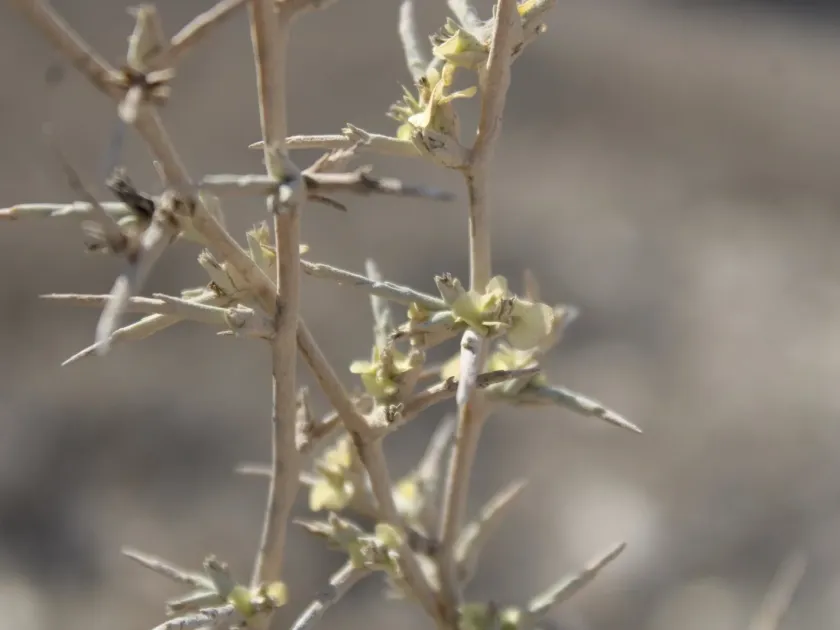
Description
Growing requirements
Noaea mucronata is a resilient perennial subshrub belonging to the Amaranthaceae family. It is widely distributed across the arid regions of the Middle East, Central Asia, and the Caucasus, showcasing remarkable adaptation to extreme environmental conditions.
Botanically, the plant features specialized structural adaptations, such as rigid, needle-like leaves that significantly reduce water loss through transpiration. This makes it a primary model for understanding xerophytic survival in desert-like climates.
The plant thrives in diverse soil types, including rocky, gravelly, and saline substrates. It possesses a deep-reaching root system, enabling it to stabilize loose soil surfaces and compete for moisture in environments where annual rainfall is extremely scarce.
Requirements for successful growth include full sun exposure and excellent drainage. It is highly sensitive to waterlogging; therefore, areas with heavy clay or poor drainage are unsuitable for the propagation of this species.
In terms of agricultural utility, Noaea mucronata serves as a vital component in land restoration projects. By improving soil structure and preventing wind erosion, it plays a key role in the long-term management of fragile ecosystems in arid farming zones.
Main diseases and pests
Noaea mucronata exhibits strong innate resistance to many common agricultural pathogens. Its high salt content and thick cuticle provide an effective physical and chemical barrier against fungal and bacterial infections.
While the species is robust, it can be affected by specific insect larvae that specialize in feeding on the stems of Amaranthaceae. However, these interactions are usually localized and do not reach epidemic levels in natural populations.
Overgrazing remains the most significant threat to the survival and expansion of these plants. Heavy livestock pressure prevents the species from reaching maturity and limits the production of viable seeds, leading to gradual population decline.
Soil disturbance caused by intensive agricultural machinery can lead to the destruction of the fragile topsoil layer where these seeds germinate. Once the root system is disrupted, the recovery of a plant often becomes impossible.
Effective management requires controlled grazing schedules and the protection of natural habitats. By implementing conservation strategies, farmers can preserve the genetic diversity of this plant, which may hold potential for future bio-technological applications in drought-prone areas.