
Mestoklema arboriforme
Mestoklema arboriforme
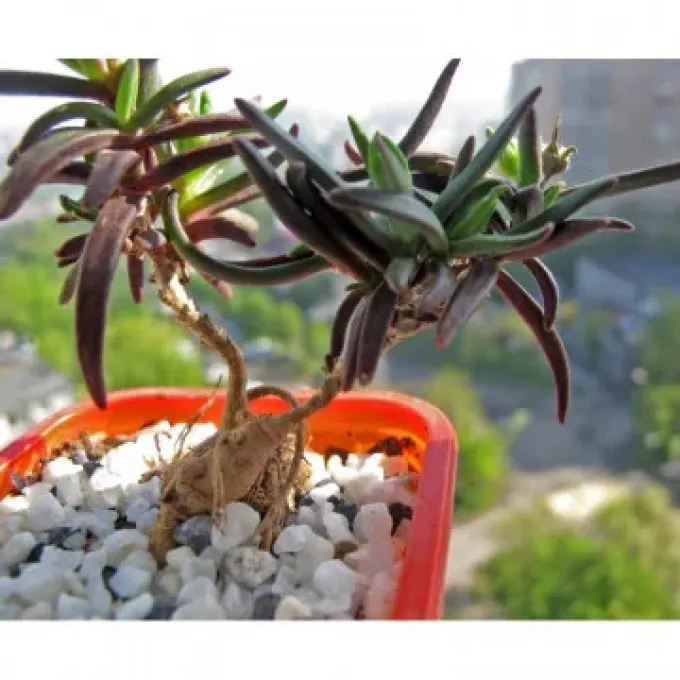
Description
Sowing dates
Mestoklema arboriforme belongs to the Aizoaceae family. It is a caudiciform succulent shrub native to South Africa, highly valued for its woody structure and its ability to thrive in harsh, arid environmental conditions.
Seeds are typically sown in late spring when warm temperatures are consistent. A well-draining substrate, such as a mix of coarse sand and inorganic potting media, is essential to ensure healthy germination and seedling development.
Optimal germination occurs at temperatures between 22 and 25 degrees Celsius. It is crucial to maintain slight moisture initially, then gradually reduce it to prevent damping-off, a common fungal issue in succulent seedlings.
Transplanting should be handled with care once the young plants develop several pairs of true leaves. Since the plant grows slowly, it requires a stable environment and minimal disturbance to its root system during the first year.
Propagation through stem cuttings is also a common practice. Cuttings must be left to air-dry for several days to allow a callus to form on the cut surface, preventing rot before planting them into dry, porous soil.
Growing requirements
As a native of dry southern African regions, this plant requires high light intensity for healthy growth. Full sunlight or very bright filtered light is necessary to keep the stems compact and prevent etiolation.
The soil must be extremely porous. A mixture consisting of 70% mineral components, such as pumice or grit, and 30% organic matter like specialized succulent potting mix, is highly recommended to avoid water retention.
Watering should follow a seasonal pattern: abundant but infrequent waterings during the active growing season, and almost complete dryness during the winter dormancy period. Never allow the plant to sit in standing water.
Excellent ventilation is vital for Mestoklema arboriforme. Stagnant air combined with humidity increases the risk of fungal pathogens, especially in environments where the temperature does not drop sufficiently at night.
During the dormant winter season, the plant benefits from a cooler climate, ideally between 10 and 15 degrees Celsius. This mimics its natural environment and helps the plant preserve energy for the upcoming growing season.
Main diseases and pests
Root rot is the most significant threat to the health of Mestoklema arboriforme. It is almost always caused by excessive moisture and poor soil drainage. If the caudex or stems feel soft, emergency repotting into dry media is required.
Mealybugs are the most common pests, often hiding in the small crevices between the leaves. Regular inspection and targeted application of systemic or contact insecticides are necessary to manage infestations early.
Spider mites may affect the plant in conditions of low humidity and stagnant air. These pests are difficult to spot initially, so frequent monitoring of the leaf texture is recommended to ensure the plant remains healthy.
Scale insects can also infest the stems. If detected, they should be removed manually, or the plant should be treated with appropriate horticultural oils to suffocate the pests without damaging the sensitive succulent tissue.
Poor light is a secondary threat that indirectly leads to disease. When the plant etiolates, its cellular structure weakens, making it significantly more susceptible to bacterial infections and infestations by sap-sucking insects.