
Twayblade
Listera
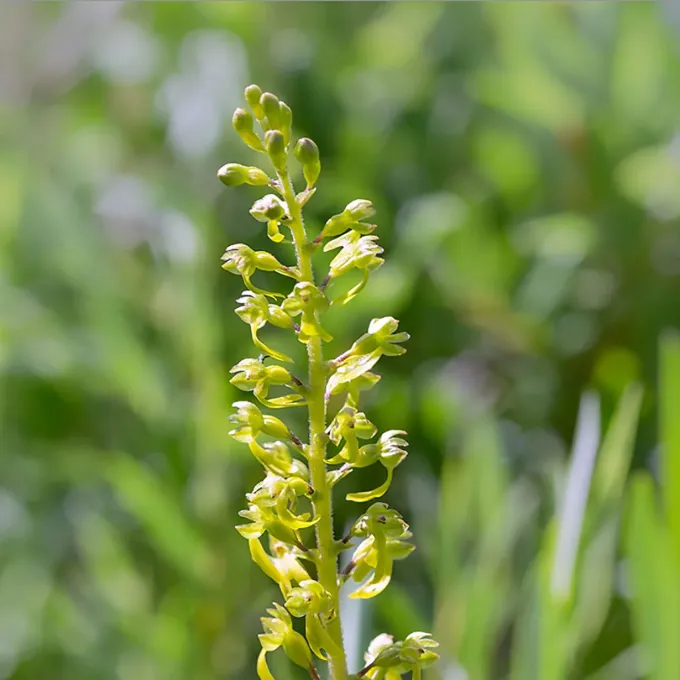
Description
Growing requirements
Twayblade (genus Listera, often reclassified as Neottia) is a group of perennial herbaceous plants belonging to the Orchidaceae family. These plants are wild forest species and are not cultivated for agricultural or commercial purposes. They are renowned for their delicate appearance and specific ecological niche.
The distribution of Twayblade covers the temperate regions of the Northern Hemisphere. They are typically found in moist coniferous and deciduous forests, often thriving in shady areas with high levels of organic matter. Their habitat is restricted to stable woodland environments where the canopy provides consistent protection.
Botanically, the plant is characterized by a pair of opposite leaves located halfway up the stem, a feature that distinguishes it from many other forest orchids. The root system consists of a short rhizome that relies heavily on mycorrhizal fungi for nutrient absorption, making the plant dependent on healthy forest soil conditions.
The environmental requirements for Twayblade are strict. It needs high humidity, stable temperatures, and deep shade. The plant is extremely sensitive to changes in soil moisture and light intensity. Because of its dependence on a specific fungal symbiosis, it cannot be easily transplanted into artificial or garden environments.
There is no industrial or agricultural use for Twayblade. It remains a subject of botanical interest and conservation efforts. It is not a crop, and therefore, no agrotechnical procedures, such as sowing or fertilization, are applicable or practiced for this genus.
Main diseases and pests
The primary threats to Twayblade populations are related to habitat loss. Deforestation, drainage of wetlands, and fragmentation of forest landscapes significantly reduce the survival chances of these sensitive orchids. Human encroachment often destroys the delicate microclimate they require.
Natural threats include forest slugs and snails, which can consume the succulent foliage during the spring growth period. Furthermore, any disturbance to the soil structure, such as trampling or machinery use, can crush the rhizomes and disrupt the surrounding fungal networks essential for the orchid's survival.
Pathogenic threats are usually associated with waterlogged conditions in areas where the natural drainage has been impaired. Excess humidity, combined with lack of ventilation, can promote the growth of mold and rot, which easily affect the rhizomatous structures of the plant.
The use of chemical substances like fertilizers, herbicides, or fungicides in the vicinity is highly detrimental. These chemicals are toxic to the mycorrhizal fungi that support the plant, essentially starving the orchid and leading to the collapse of the local population.
Conservation strategies focus on protecting existing forest habitats rather than managing individual plants. Because Twayblade is not a cultivated species, disease and pest management are generally not implemented, and the focus remains solely on habitat preservation and ecological monitoring.