
Koompassia excelsa
Koompassia excelsa (Becc.) Taub.
Description
Growing requirements
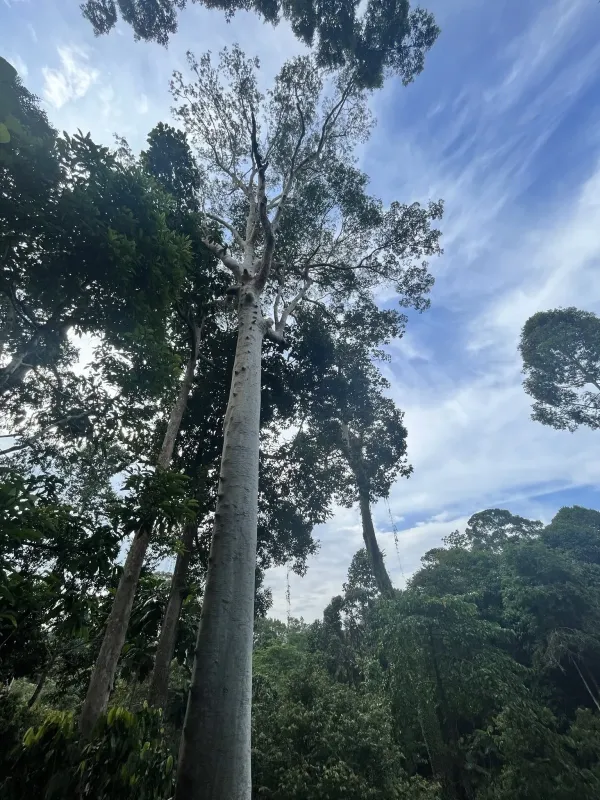
Koompassia excelsa, commonly known as Tualang, is a giant tree belonging to the Fabaceae family. It is recognized as one of the tallest flowering plant species in the world, dominating the canopy of Southeast Asian rainforests.
The species is native to the primary lowland rainforests of Malaysia, Indonesia, and the Philippines. It thrives in humid tropical environments where rainfall is abundant throughout the year and soil fertility remains high due to rapid organic matter turnover.
Botanically, the tree is characterized by a massive, smooth trunk with large buttress roots. Its leaves are pinnate, and it produces numerous small, yellowish flowers that are pollinated by insects, leading to the development of winged, papery pods.
In terms of agricultural requirements, this tree is not typically cultivated as a traditional crop but rather managed through sustainable forestry practices. It requires deep, well-drained alluvial soils and an environment that mimics its natural successional stage in the rainforest.
The economic value of this tree lies in its timber, marketed as Kempas. The wood is highly valued for its extreme hardness, durability, and resistance to wear, making it an excellent material for heavy-duty flooring and bridge construction.
Main diseases and pests
The primary threat to Koompassia excelsa is habitat destruction, specifically deforestation for agricultural land expansion. As a canopy giant, it cannot survive in fragmented or degraded forest patches.
Insect pests, including various species of termites and wood-boring beetles, pose a risk primarily to harvested timber or stressed individual trees within the forest ecosystem.
Fungal pathogens can be problematic during the seedling stage, particularly in nurseries where high humidity can lead to "damping-off" diseases if hygiene protocols are not followed strictly.
Human-induced wildfires have become an increasingly severe threat to Tualang populations, as they are not evolutionarily adapted to frequent fires, unlike some savanna species.
Reduced genetic diversity due to isolated tree populations makes the species vulnerable to shifts in climate patterns and diseases that might emerge in rapidly changing tropical environments.