
Jasonia tuberosa
Jasonia tuberosa
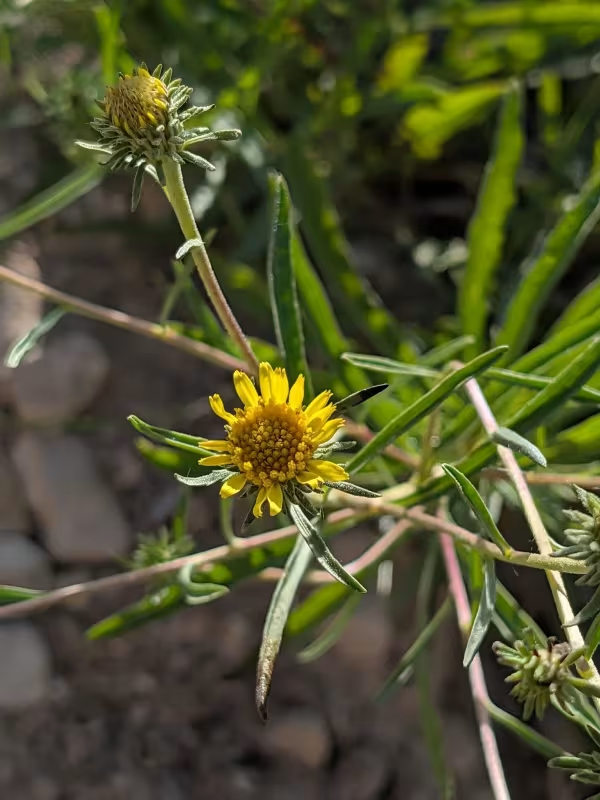
Description
Sowing dates
Sowing Jasonia tuberosa is typically scheduled for early spring once the soil temperature consistently reaches 12–15 degrees Celsius. Ensuring moisture levels are maintained during the initial germination phase is crucial for success.
Seeds should ideally be stratified in moist sand for two to three weeks prior to planting to break dormancy and increase uniformity in emergence. Seeds are sown at a depth of 1–2 centimeters in well-prepared seedbeds.
Standard agricultural practice involves row planting with 45–50 centimeters between rows. This spacing allows for adequate airflow and provides space for weeding operations during the early vegetative stage.
Vegetative propagation via tubers is an alternative method, planting them at a depth of 5–7 centimeters. This technique is often preferred in smaller operations to achieve faster establishment and more predictable plant density.
Regardless of the method, selecting high-quality planting material is essential. Avoid overcrowding, as young plants require significant sunlight to develop the initial rosettes that support future growth.
Growing requirements
Jasonia tuberosa, a member of the Asteraceae family, thrives in open areas with full sun exposure. Shaded environments drastically reduce the plant's ability to synthesize active compounds and weaken the stalk structure.
The ideal soil profile consists of light, sandy-loam textures with excellent drainage properties. Soils prone to waterlogging must be avoided, as the species is highly susceptible to root-related issues in stagnant water.
The plant is naturally adapted to Mediterranean-like climates and exhibits high drought tolerance once established. It thrives during warm, dry periods but requires consistent moisture during the early vegetative stage.
Soil pH should ideally be neutral or slightly alkaline. In acidic soil conditions, liming is recommended prior to planting to ensure the availability of essential micronutrients for optimal metabolic function.
Fertilization management should focus on phosphorus and potassium to encourage robust root and tuber development. Excess nitrogen should be avoided, as it promotes excessive leafy growth at the expense of root quality.
Yield
The yield of aerial biomass for Jasonia tuberosa is typically in the range of 1.5 to 2 tons per hectare. Performance is highly dependent on weed suppression and soil fertility management throughout the growing season.
Tuber production is a valuable secondary output, with individual plants potentially yielding 100–200 grams of biomass. Harvesting usually occurs on a biennial or triennial basis to ensure maximum tuber size.
Consistent productivity is achieved when planting density is optimized. Studies suggest that beyond the third year, yields may begin to decline, necessitating crop rotation or soil rejuvenation techniques.
Harvest timing is critical; yield components (active pharmacological substances) fluctuate throughout the life cycle. Maximizing the harvest of these compounds requires precise synchronization with the flowering stage.
Irrigation management, particularly in arid years, can boost yield potential by up to 30–40 percent compared to rain-fed crops. Controlled water application mimics natural precipitation cycles favored by the plant.
Main diseases and pests
Fungal diseases are the primary threat, often stemming from poor drainage or excessive humidity. Root rots and crown rot are common if the plants are subjected to waterlogged soil conditions for extended periods.
Pests such as aphids and spider mites can infest the foliage during hot, dry spells. Integrated pest management (IPM) strategies, including biological controls, should be employed to mitigate these populations.
Powdery mildew can emerge in dense plantings with poor circulation. Ensuring recommended row spacing and maintaining weed-free fields are standard practices to prevent fungal outbreaks in the field.
Weeds are the most significant competitor during the crop's establishment phase. Mechanical weeding or manual labor is preferred over chemical herbicides, as the crop is sensitive to many common agricultural pesticide formulations.
Soil-borne pests like wireworms may occasionally target the tubers. A pre-planting soil analysis and pest count are recommended if the land was previously utilized for cereal crop production.
Harvesting
Harvesting the aerial parts is best conducted at the onset of peak flowering. Cutting should be performed using mechanical harvesters or sharp blades, ensuring a clean cut above the base to protect the plant for regrowth.
Post-harvest, the raw material must be transported quickly to a drying facility. The drying process should occur at temperatures between 35 and 40 degrees Celsius to prevent the degradation of volatile essential oils.
Tubers are harvested in late autumn after the aerial biomass has completely senesced. They must be carefully lifted to avoid bruising, which could lead to spoilage during the curing and storage process.
Following harvest, raw material must be sorted to remove any damaged or diseased parts. Proper sorting maintains the quality of the entire batch and prevents cross-contamination during warehouse storage.
Dry storage must be maintained in dark, well-ventilated conditions with low humidity levels. Proper packaging using paper or woven bags helps maintain product integrity for up to two years.