
Red flinders grass
Iseilema vaginiflorum
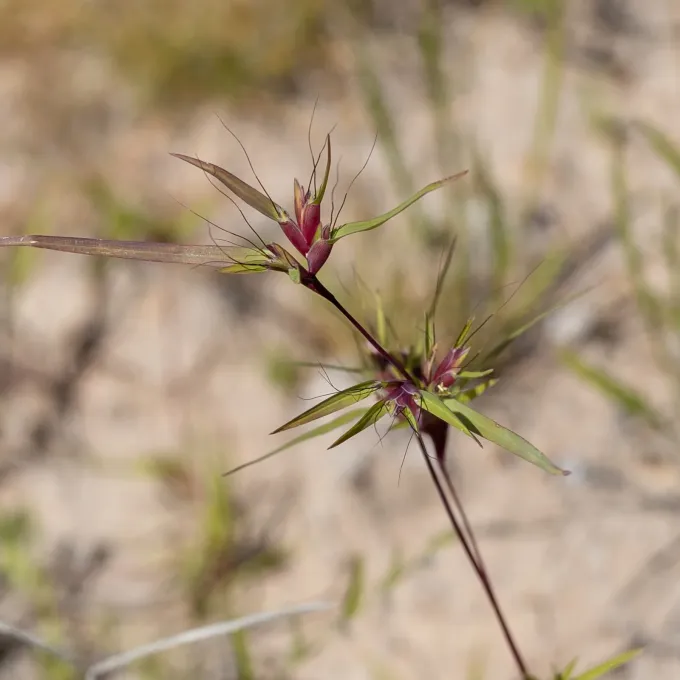
Description
Growing requirements
Red Flinders grass (Iseilema vaginiflorum) is an annual grass species belonging to the Poaceae family. In agronomic practice, it is recognized as a premier forage plant in the arid and semi-arid regions of Australia, where it serves as a staple for grazing livestock.
The plant is native to tropical and subtropical environments and is specifically adapted to heavy clay soils. These soil types are crucial for the plant's survival, as they retain moisture effectively during the erratic rainfall cycles characteristic of its native habitat.
Botanically, it is characterized by its ability to form dense, productive swards. The grass has a relatively shallow but highly efficient root system that rapidly responds to seasonal moisture, allowing for quick biomass accumulation.
Climatic requirements involve a cycle of heat and periodic wetting. The species is highly tolerant of high temperatures, which helps it dominate in ecosystems where other, less resilient species might fail during the dry season.
Agronomic management of this species is largely based on ecological grazing practices. Since it is a prolific self-seeder, minimal soil disturbance is required, and sustainability is maintained by allowing the plant to reach the seed-setting stage periodically.
Yield
The primary agricultural utility of Iseilema vaginiflorum lies in its high nutritional value as a grazing resource. It is favored by beef cattle and sheep for its palatability and protein content during the peak growing season.
Yields are highly dependent on early-season precipitation, but the grass is known for its ability to produce substantial leaf mass rapidly. This makes it an essential fodder crop for maintaining stock condition in extensive ranching systems.
In terms of forage quality, the plant maintains a good nutritional profile even as it matures. Once the growth cycle ends, the standing hay provides a critical safety net for livestock during the drier months when fresh vegetation is scarce.
The efficiency of the crop is often measured by the stocking rate capacity it supports. Properly managed paddocks with established stands of Red Flinders grass can support significant herd numbers without long-term damage to the pasture composition.
Overall, the crop is considered a low-input, high-reward component of natural grassland management, contributing significantly to the economic viability of livestock operations in its native range.
Main diseases and pests
The primary threat to the stability of Red Flinders grass populations is overgrazing. Continuous, heavy grazing pressure prevents the plant from setting seed, which is vital for its regeneration as an annual species.
Extended, severe droughts are another significant concern. While the species is drought-tolerant, extreme weather patterns can exhaust the seed bank in the soil, leading to a temporary decline in population density.
Pests such as grasshoppers and certain lepidopteran larvae can cause defoliation, though outbreaks are generally sporadic and rarely require chemical intervention in an extensive grazing context.
Invasive weed species can compete for space and nutrients if the stand is stressed or if soil disturbance occurs, highlighting the need for careful ecological management.
To mitigate these threats, successful farmers implement rotational grazing strategies that ensure the grass can cycle through its reproductive phase, thereby guaranteeing the persistence of the stand for future seasons.