
Marsh pennywort
Hydrocotyle vulgaris
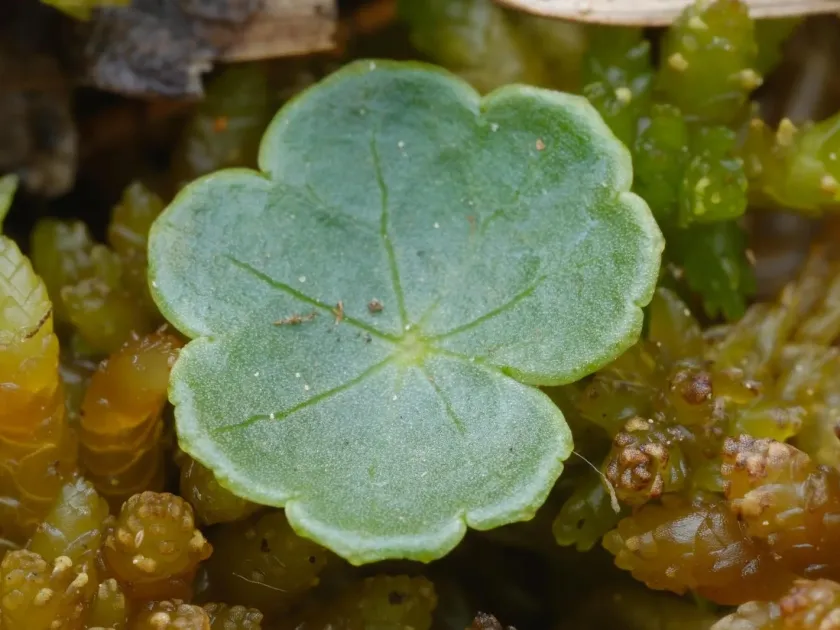
Description
Growing requirements
Marsh pennywort (Hydrocotyle vulgaris) is a perennial herbaceous plant belonging to the Araliaceae family. It is naturally adapted to wet environments, thriving in marshes, bogs, and along the margins of ponds and streams.
The cultivation of this species requires specific environmental conditions, primarily high moisture levels and consistent water availability. It is strictly a wetland plant that struggles to survive in standard garden soil unless kept saturated.
When choosing a planting site, select areas with full sun or partial shade. The soil should ideally be acidic and rich in organic matter. Marsh pennywort is highly effective in nutrient-poor environments but responds well to minor nutrient influxes in aquatic systems.
Climate tolerance is moderate, as the plant is hardy in most temperate regions. During winter, the foliage may die back, but the creeping rhizomes remain dormant under the substrate, ready to sprout again when temperatures rise in spring.
A key aspect of agronomy for this species is managing its growth rate. The plant spreads via creeping, rooting stems, which can quickly colonize large areas if not checked, making regular maintenance necessary in smaller managed plots.
Harvesting
Harvesting usually takes place from late spring through early autumn, corresponding to the peak period of vegetative growth. During this time, the leaves are harvested for their potential traditional medicinal applications.
For sustainable harvesting, gather only the required amount of foliage to allow the plant to continue its regenerative growth. Proper drying techniques, such as using shaded, well-ventilated areas, are essential for preserving the plant's quality.
In landscape management, the plant is harvested or thinned to maintain the balance of aquatic ecosystems. Preventing the plant from choking out other sensitive flora is a standard practice for maintaining biodiversity in natural ponds.
Economically, Marsh pennywort is primarily valued in the ornamental sector for water garden landscaping. It serves as a natural groundcover that helps stabilize soil in damp, prone-to-erosion areas near water bodies.
Propagation is most efficiently achieved through the division of rhizomes. Each section of the creeping stem with roots attached can be transplanted directly into a new, wet location, ensuring rapid establishment of the crop.