
Haematococcus lacustris
Haematococcus lacustris (Girod-Chantrans) Rostafinski
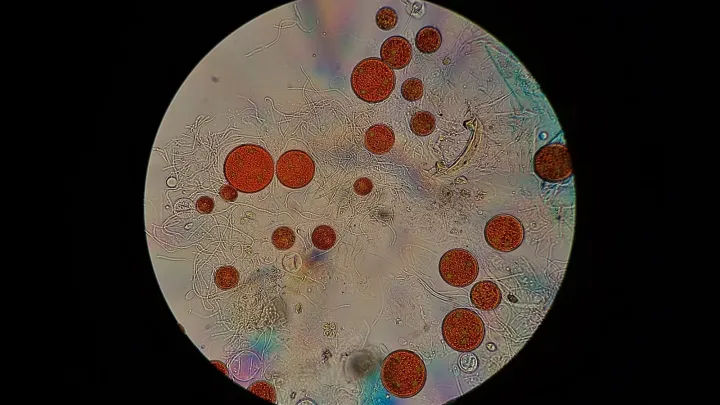
Description
Sowing dates
Haematococcus lacustris is a freshwater microalga belonging to the family Haematococcaceae. In agricultural biotechnology, the "sowing" process involves inoculating a controlled nutrient medium with a pure strain under sterile conditions.
The process is scaled up from small laboratory flasks to large photobioreactors or open ponds. Ensuring the genetic purity of the inoculum is essential to prevent contamination and maintain high productivity throughout the growth cycle.
Initial inoculation density is calculated to optimize the light-path length and maximize photosynthetic efficiency. Proper setup of the cultivation system prevents early-stage die-offs and promotes rapid population growth.
The life cycle begins with a green motile stage, which is the vegetative phase. Farmers monitor this stage closely to ensure the population reaches the desired biomass density before triggering the accumulation phase.
Scheduling is dictated by the operational capacity of the facility and the optimization of resource inputs. Consistent monitoring of growth kinetics allows for precise determination of when to move to the next production stage.
Growing requirements
Cultivation requires high light intensity, as the organism is photoautotrophic. However, in industrial settings, light must be managed carefully to avoid photo-oxidative stress before the intended accumulation phase.
The optimal temperature for growth ranges between 20°C and 25°C. Deviations from this range can lead to significant reductions in metabolic activity or unwanted shifts in the population's health.
The growth medium must provide balanced macro-nutrients, particularly nitrogen and phosphorus, along with essential trace elements. Maintaining a stable pH between 6.5 and 8.0 is critical for nutrient uptake and system stability.
Aeration and agitation are required to prevent cell sedimentation and ensure consistent access to dissolved CO2. Efficient gas exchange is a fundamental requirement for achieving high biomass concentrations.
Water quality must be strictly controlled, as Haematococcus lacustris is sensitive to high salt concentrations and the presence of heavy metals, which can inhibit development.
Yield
Yield is measured as biomass density (g/L) and, more importantly, the concentration of astaxanthin within the dried biomass. Efficient systems can produce significant quantities of high-value pigments per production cycle.
The accumulation of astaxanthin is triggered by stress, such as nitrogen depletion or high light exposure, which forces the algae to transition into a red, encysted state to protect its genetic material.
Modern photobioreactors have improved yield by optimizing light distribution, allowing for higher cell densities that were previously impossible to achieve in traditional open-pond systems.
Limiters to yield include high culture density that creates shading, preventing light from reaching inner cells, and the accumulation of oxygen as a byproduct which can be toxic at high levels.
Yield stability relies on the consistent maintenance of environmental parameters, allowing for multiple harvests per year and a predictable supply of high-grade raw materials.
Main diseases and pests
The most significant threat to a culture of Haematococcus lacustris is infection by parasitic chytrids, which can cause total colony collapse within a very short timeframe.
Contamination by other opportunistic algae or protozoa is a frequent issue. These contaminants can rapidly overtake the culture, reducing the overall purity and efficacy of the final harvest.
Viral pathogens present a specific challenge, as they can cause mass lysis of the cells. Maintaining sterile environments and proper quarantine procedures for new inocula is the primary defense strategy.
Environmental stressors that are poorly managed, such as extreme pH fluctuations, can weaken the cell walls, making the population more susceptible to secondary fungal or bacterial infections.
Standard sanitation protocols, including the thorough disinfection of all harvesting and transport equipment, are essential for preventing the spread of threats across production modules.
Harvesting
Harvesting is typically performed via centrifugation, which effectively separates the algae cells from the culture medium. The concentrated slurry is then processed for downstream applications.
Post-harvest treatment often includes gentle drying, such as spray drying, to maintain the chemical integrity of the astaxanthin, which is highly sensitive to heat and oxidation.
In many processes, cell wall disruption is necessary to improve the bioavailability of the bioactive compounds. This is achieved using mechanical homogenization or controlled enzymatic treatment.
The storage of the finished biomass requires vacuum sealing or nitrogen flushing to prevent oxidation. Protecting the product from UV exposure is vital to maintaining the pigment's stability.
The final product is widely used in the nutraceutical industry, human dietary supplements, and as a natural colorant and health supplement in high-end aquaculture feed for salmon and trout.