
Furcraea cabuya
Furcraea cabuya Trel.
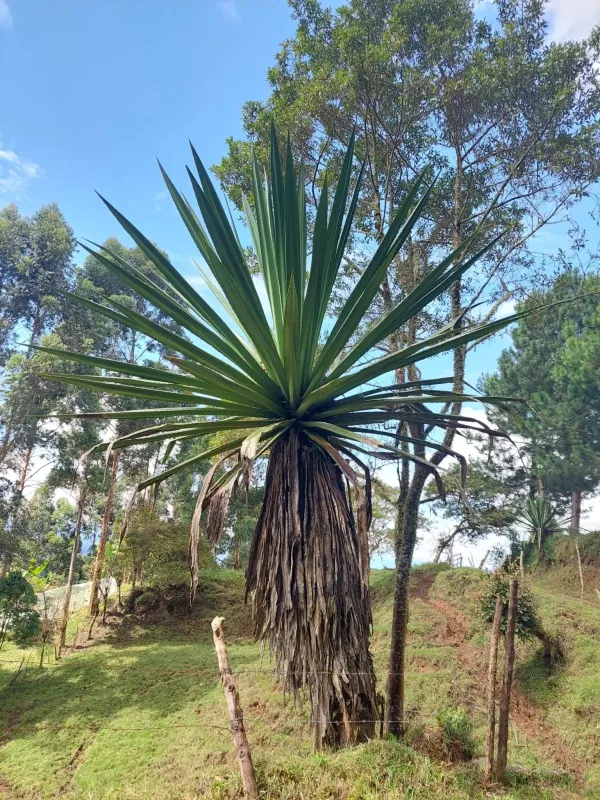
Description
Sowing dates
Furcraea cabuya is primarily propagated vegetatively, as seed reproduction in agricultural settings is difficult due to the plant's long development cycle.
The main planting material consists of bulbils (aerial bulbils) that form on the inflorescence stalks of adult plants in large quantities.
To establish commercial plantations, young plants are pre-grown in nurseries until they are ready for field transplanting, which takes about 6 to 10 months.
Transplanting into the field is carried out at the beginning of the rainy season to ensure optimal survival rates for young seedlings and sufficient soil moisture.
Planting density varies depending on the intended use and plantation mechanization, typically ranging from 2,500 to 4,000 plants per hectare.
Growing requirements
The crop belongs to the Asparagaceae family and is a tropical perennial that requires consistently high temperatures for healthy growth without sharp fluctuations.
The plant prefers well-drained sandy-loam soils and cannot tolerate waterlogging, which quickly leads to the rotting of the root system.
Furcraea cabuya shows high resistance to drought periods, but it requires moderate and regular irrigation to actively increase its leaf mass.
Optimal growth conditions are provided by bright sunlight, although during the initial growth stages, young plants may require light shading.
A critical factor is the absence of frost, as the plant's tissues, which are rich in moisture, are instantly damaged by sub-zero temperatures.
Yield
The economic value of Furcraea cabuya lies in the production of high-strength technical fiber, which is found in the leaves in significant concentrations.
Yield of leaf mass depends directly on the quality of care, the age of the plantation, and the intensity of organic and mineral fertilizer application.
Harvesting begins 3–4 years after transplanting to the permanent site, when the leaves reach optimal length and fiber maturity.
On average, one hectare of plantation under intensive management can yield up to 15–20 tons of raw leaf mass for primary processing.
The yield of pure fiber is approximately 3-5% of the total mass of the processed leaves, making this culture a profitable alternative to other bast fiber crops.
Main diseases and pests
Furcraea cabuya is highly resistant to most pathogens, but in conditions of excessive moisture, it is susceptible to fungal diseases.
The greatest threat comes from root and stem rots, which develop due to improper irrigation practices or the selection of unsuitable plots.
Among pests, serious damage can be caused by various species of scale insects and mealybugs, which suck sap from the young leaves.
In some regions, plantations suffer from weevil infestations, where larvae damage the central growth point, leading to the death of the entire plant.
To prevent the spread of diseases, it is necessary to maintain proper airflow in the plantations and regularly remove damaged or diseased leaves.
Harvesting
Harvesting Furcraea is a labor-intensive process that involves cutting mature leaves at the base of the stem without damaging the central rosette.
Leaves are cut as they mature, ensuring the possibility of multiple harvests from the same plant over several years.
After harvesting, the leaves must be transported immediately to the decortication line for fiber extraction to avoid sap oxidation.
Special decortication machines are used in the process to break down the leaf tissue and separate the fibrous fraction from the plant pulp.
The resulting fiber undergoes a mandatory washing stage, sun-drying, and subsequent combing to prepare it for industrial application.