
Frullania tamarisci
Frullania tamarisci
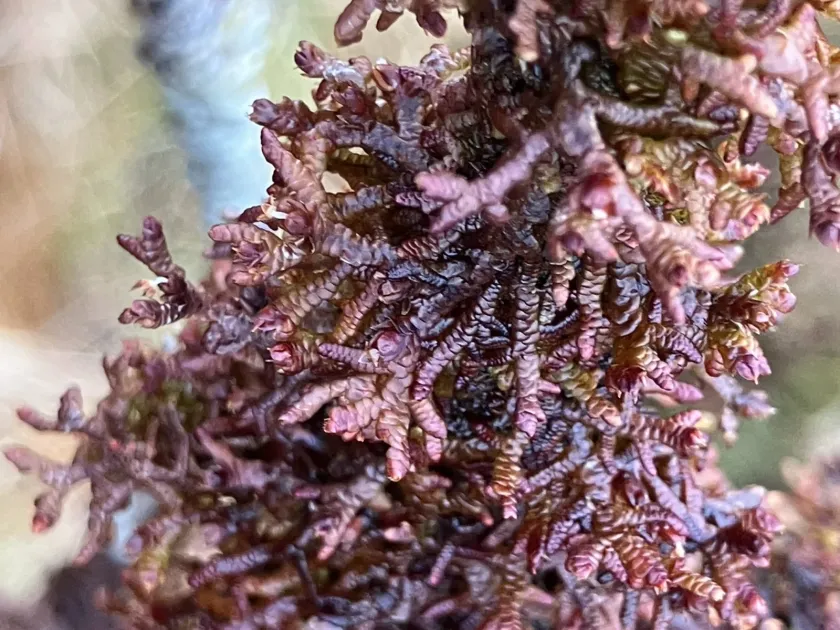
Description
Growing requirements
Frullania tamarisci is a leafy liverwort belonging to the family Frullaniaceae. It is not an agricultural crop but a significant component of forest ecosystems, commonly found growing on bark, rocks, and occasionally on soil in humid environments.
Morphologically, it forms dense, reddish-brown or dark green mats. Its characteristic branched structure allows it to maintain moisture efficiently, which is essential for its survival in temperate and oceanic climates.
The plant has strict environmental requirements, thriving in areas with high humidity, cool temperatures, and consistent air moisture. It is most commonly associated with undisturbed forest regions where fog and rainfall are frequent.
Regarding its substrate, it acts as an epiphyte, colonizing the bark of various trees such as oak, beech, and conifers. The acidity of the substrate plays a crucial role in its colonization success, as it prefers slightly acidic to neutral surfaces.
As it is not cultivated commercially, no traditional agronomic practices are applied. Conservation efforts focus on protecting the natural habitats where this bryophyte grows to ensure the maintenance of local ecological balance.
Main diseases and pests
Deforestation and habitat fragmentation are the primary threats to Frullania tamarisci populations. The loss of mature, bark-covered trees directly eliminates its natural growing space and alters the local microclimate.
Atmospheric pollution, particularly sulfur dioxide, is highly toxic to this species. Because it absorbs nutrients and moisture directly from the air, it is extremely sensitive to poor air quality and serves as a natural indicator of environmental health.
Climate change, manifesting as prolonged droughts or unpredictable rainfall patterns, poses a significant risk. The inability of the plant to withstand extended dry periods can lead to the death of entire colonies.
Interspecific competition from fast-growing lichens or invasive vascular plants can displace Frullania tamarisci from its niche, especially in areas where canopy cover has been thinned by human activity.
Pathological issues are generally minimal under optimal conditions, but in disrupted ecosystems, opportunistic fungi can exploit weakened colonies, leading to rapid degradation of the bryophyte structure.