
Flax
Linum usitatissimum convar. usitatissimum
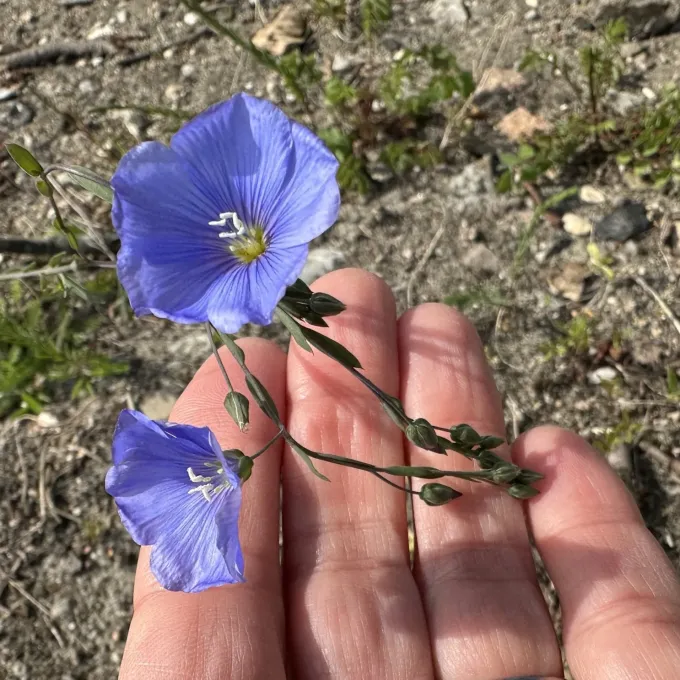
Description
Sowing dates
The sowing of common flax is carried out in early spring, as soon as the soil warms up to 7-10 degrees Celsius. The optimal sowing time coincides with the start of field moisture retention operations, which is critical for obtaining uniform germination.
For high-quality sowing, standard drill seeders are used with a row spacing of 7.5-15 cm. This sowing density promotes the formation of upright stems, which is necessary to obtain high-quality flax fiber.
The sowing depth is 1.5–3 cm depending on the soil type and moisture content. With deeper sowing, the germination energy significantly decreases, which leads to thinning of the crops.
An important technique is soil rolling immediately after sowing to ensure better seed-to-soil contact. This facilitates faster capillary moisture movement to the germination zone.
If necessary, post-sowing harrowing with light harrows is performed to prevent the formation of soil crust and to control early weed growth.
Growing requirements
Flax belongs to the Linaceae family and is a moisture-loving crop with a short growing season. It is successfully cultivated in regions with a temperate climate and sufficient rainfall in the first half of summer.
The crop has high requirements for soil fertility: sod-podzolic loams and sandy loams with a neutral or slightly acidic reaction show the best results. It is important to avoid waterlogged areas with standing water.
The temperature regime is important for flax during the germination stage: seeds begin to sprout at 3-5 degrees Celsius, and seedlings can withstand brief frosts down to minus 3-4 degrees.
For normal development, plants require moderate air humidity during the flowering period. Excessive heat and drought during this time sharply reduce fiber yield and seed quality.
The flax fertilization system is based on applying nitrogen, phosphorus, and potassium in balanced doses. An excess of nitrogen fertilizers can lead to crop lodging, which critically complicates subsequent harvesting.
Yield
The yield of common flax varies depending on the type of variety cultivated: fiber flax or oilseed flax. Modern varieties allow for consistently high performance when adherence to technology is maintained.
The average yield of flax straw ranges from 30 to 50 centners per hectare under industrial conditions. With intensive cultivation technologies, this figure can be significantly higher.
The seed yield of fiber flax is usually 5-10 centners per hectare, while oilseed varieties can yield 15-20 centners per hectare. These figures depend heavily on seed material quality and seasonal weather conditions.
The quality of the final product is determined not only by mass but also by the output of long fiber. This indicator is decisive for the economic efficiency of a flax-growing enterprise.
Factors affecting productivity include crop rotation: flax cannot be returned to the same field sooner than after 6-7 years to avoid the accumulation of specific soil pathogens.
Main diseases and pests
The most dangerous disease of flax is "flax sickness," caused by soil-borne fungi of the Fusarium genus. This leads to mass seedling mortality and reduced fiber quality.
Anthracnose and pasmo disease can affect all plant organs at different growth stages. To combat them, seed treatment with systemic fungicides before sowing is applied.
Among pests, the flax flea beetle causes the greatest damage by destroying the cotyledons of young seedlings in dry weather. Upon reaching the economic damage threshold, crops are treated with insecticides.
Thrips and the flax bollworm can damage the plant's generative organs, reducing oil content and seed germination. Monitoring crops during the budding stage is a mandatory measure.
- Fusarium wilt
- Anthracnose
- Flax flea beetle
- Flax bollworm
- Pasmo disease
Harvesting
Harvesting common flax requires high precision in timing: early harvesting results in immature fiber, while late harvesting leads to over-matured and coarse fiber.
The optimal time to start work is the early yellow ripening phase. In this period, fiber content in the stems reaches its maximum, and seed quality meets sowing standards.
The main harvesting method is pulling the stems with the root. This allows for maximum preservation of fiber length and ensures high quality of the flax produce.
After pulling, the flax is spread in ribbons on the field for the dew retting process. Under the influence of dew and moisture, the pectin substances connecting the fibers decompose.
The final stage of harvesting is the collection of flax straw and its transportation for primary processing. The speed of execution determines the preservation of the commodity qualities of the flax.