
Amorpha fruticosa
Amorpha fruticosa L.
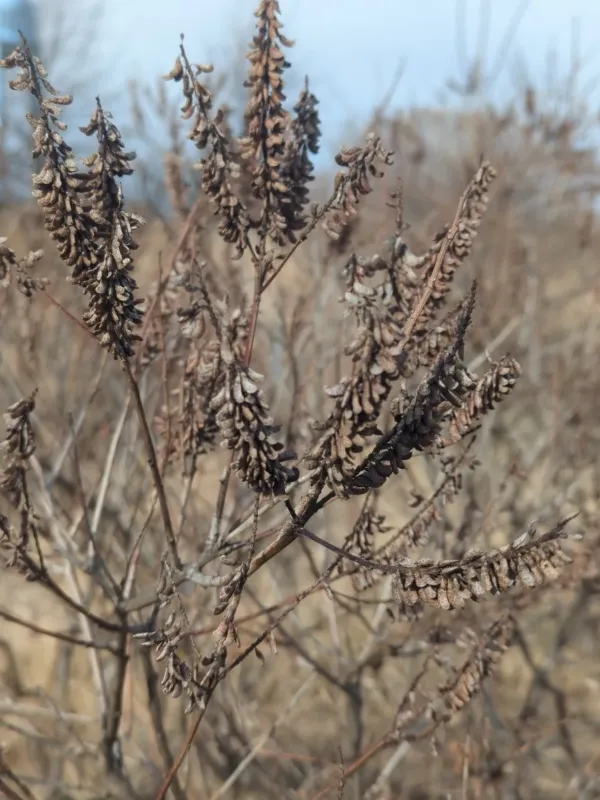
Description
Sowing dates
The sowing of Amorpha fruticosa is best performed in the autumn, allowing the seeds to undergo natural stratification in the soil. For spring planting, seeds must undergo cold stratification at approximately 5°C for about two months to break dormancy and ensure uniform germination.
Seeds should be sown in rows at a depth of 2–3 centimeters. Maintaining a row spacing of 50–70 centimeters is recommended to facilitate future maintenance and provide adequate space for the shrubs to develop their characteristic canopy.
For establishing shelterbelts or decorative hedges, nursery-grown yearlings are preferred. Planting should occur in early spring before active bud break or in late autumn after the foliage has dropped, ensuring the plants are dormant during the transition.
The plant demonstrates high growth vigor. When establishing a plantation, precise spacing is crucial to avoid overcrowding, which can lead to reduced flowering and the dieback of lower branches due to insufficient light exposure.
During the first year, young plants require consistent moisture and weed management. Their growth rate is moderate initially as the plant invests significant energy into establishing its deep, nitrogen-fixing root system.
Growing requirements
Amorpha fruticosa is a member of the Fabaceae family and thrives in full sun. While it exhibits some tolerance to partial shade, optimal nectar production and floral density are achieved in locations with high daily solar exposure.
This species is exceptionally adaptable to various soil types, including sandy, gravelly, and nutrient-poor soils. Its extensive root system makes it an excellent candidate for soil stabilization and controlling erosion on steep, unstable slopes.
The shrub is highly climate-resilient, showing strong drought tolerance once established. It withstands a wide range of temperatures, making it suitable for temperate regions where it survives harsh winters with minimal risk of freeze damage to the main woody structure.
As a legume, Amorpha maintains a symbiotic relationship with nitrogen-fixing bacteria. Therefore, it does not require heavy nitrogen fertilization, though phosphorus and potassium applications can significantly improve floral output and overall vigor.
Although it handles dry sites well, it naturally grows along riverbanks, indicating a high tolerance for periodic moisture. However, for commercial purposes, well-drained soils are preferred to prevent root rot and ensure long-term health.
Yield
The primary economic value of Amorpha fruticosa lies in its function as a prolific honey plant. It provides an abundant source of nectar and high-quality pollen, supporting pollinator health during a critical period of the season.
The honey yield per hectare can range from 100 to 200 kilograms depending on local climatic conditions. The nectar is highly sought after by apiarists for its unique aromatic profile and high concentration of beneficial sugars.
The pollen collected by honeybees from Amorpha flowers is vital for colony development. By providing a reliable source of protein, the plant helps maintain strong, healthy hives, which can then be transitioned to other major nectar sources throughout the season.
Beyond apiculture, the biomass of the shrub is utilized in land reclamation and agroforestry. Its ability to enrich the soil with nitrogen and its fast growth rate make it a valuable asset for restoring degraded or unused farmland.
In certain contexts, the plant is processed for its chemical constituents, specifically rotenoids found in the leaves and stems, which possess natural insecticidal properties. This adds a secondary dimension to its potential as a sustainable raw material.
Main diseases and pests
Amorpha fruticosa possesses a natural resilience against most common agricultural pathogens. It is rarely affected by widespread disease outbreaks, provided that the planting site offers good airflow and adequate drainage to prevent excess humidity.
In cases of extremely dense plantings, powdery mildew may occasionally appear on the foliage. Management involves thinning the canopy to promote air circulation and, if necessary, the removal of severely affected branches to prevent further spread.
Pest pressure is generally minimal. While some leaf-feeding insects may be observed, they rarely cause sufficient damage to warrant chemical intervention. The use of pesticides is strongly discouraged in nectar-producing plantations to protect pollinator populations.
The most significant threat during the early stages of establishment is competition from invasive weeds. Mechanical weeding or the application of organic mulch around the base of the shrubs effectively suppresses weed growth and maintains soil hydration.
Overall, the plant is remarkably autonomous. Proper site selection — avoiding heavy, waterlogged soils — is the most effective strategy for ensuring the health and productivity of an Amorpha plantation without the need for constant chemical inputs.