
Tisserant's Spurge
Euphorbia tisserantii
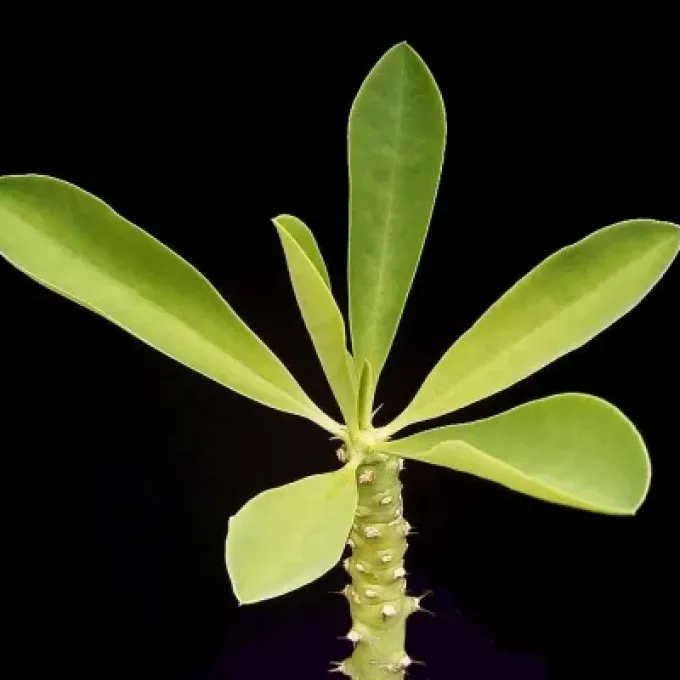
Description
Growing requirements
Euphorbia tisserantii, commonly known as Tisserant's Spurge, is a succulent shrub belonging to the Euphorbiaceae family. This species is native to Central Africa, where it has evolved to thrive in arid, rocky environments with limited seasonal rainfall.
The plant is defined by its succulent, ribbed stems, which act as water storage reservoirs. These stems feature defensive spines, a vital adaptation against herbivores in its natural habitat, allowing the plant to maintain its structural integrity during prolonged dry periods.
Cultivation requires full sun exposure to maintain compact growth and typical morphology. Shade-grown specimens often suffer from etiolation, losing their architectural character and becoming more susceptible to physical breakage and opportunistic pathogens.
The growing medium must be highly porous and inorganic-dominant, mimicking the rocky substrates of its native range. Excellent drainage is non-negotiable, as the roots are extremely sensitive to stagnant water, which rapidly leads to tissue necrosis.
Its primary use is in the horticulture industry as a unique specimen for desert-style landscapes and botanical collections. Due to its striking form, it is highly valued by enthusiasts who specialize in xeric gardening and arid-climate plant cultivation.
Main diseases and pests
The most significant threat to Euphorbia tisserantii is root rot caused by improper irrigation or poor drainage. Excess soil moisture quickly compromises the root system, often leading to rapid collapse of the succulent stems, which is difficult to reverse once started.
Common pests include mealybugs and spider mites, which exploit the protected areas between the plant's ribs and spines. These pests weaken the plant and can facilitate the secondary entry of fungal or bacterial pathogens, necessitating prompt chemical treatment.
The plant's milky sap is highly toxic and serves as a natural deterrent against insects and animals. Gardeners should exercise caution during pruning or propagation, as the sap is a potent irritant to the skin and especially the eyes, requiring protective gear.
Fungal infections are most prevalent during the dormant season if the plant is exposed to cool, humid conditions. Proper ventilation is essential to ensure that moisture does not accumulate on the stem surfaces, which would otherwise invite spore germination.
Regular monitoring for discoloration, soft spots, or unusual growth patterns is the best strategy for maintaining health. Early detection of stress allows for corrective actions, such as adjusting soil moisture or relocating the plant to a brighter position.