
Pencil cactus
Euphorbia tirucalli
Description
Growing requirements
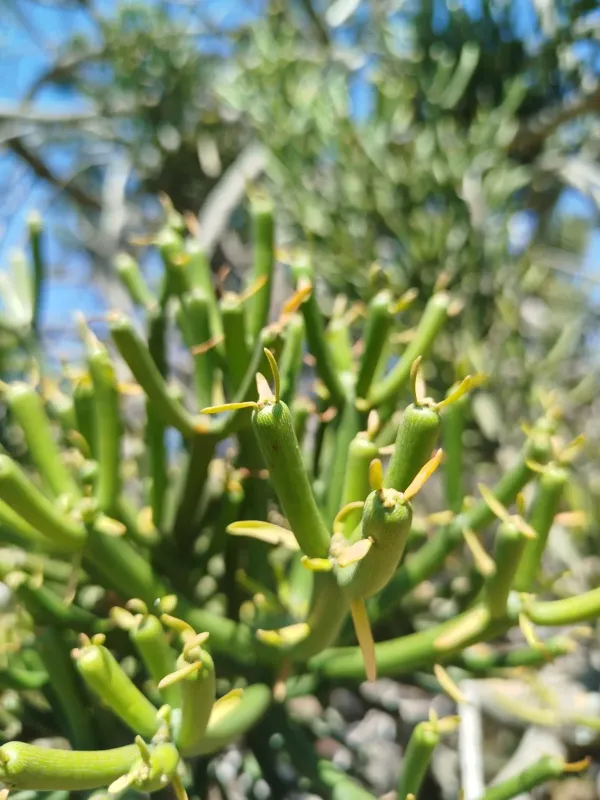
Pencil cactus (Euphorbia tirucalli) is a perennial succulent shrub belonging to the Euphorbiaceae family. It is characterized by its cylindrical, pencil-like branches that lack traditional leaves, often reaching heights of several meters in its natural habitat across tropical Africa.
This species is highly adapted to arid and semi-arid environments, making it a robust crop for regions prone to drought. Its biological resilience allows it to thrive in diverse soil conditions, provided that the drainage remains exceptional and moisture does not accumulate near the roots.
For successful cultivation, the crop requires full sun exposure and well-aerated, sandy soil. It is highly intolerant of waterlogging, which often results in severe root rot and total loss of the stand. It performs best in climates where frost is entirely absent throughout the year.
Agricultural management is primarily based on vegetative propagation using stem cuttings. The planting density is adjusted based on the intended purpose, whether it is for maximizing biomass for energy production or for specific industrial extraction processes within the chemical industry.
Routine maintenance involves monitoring water levels and managing soil nutrient content to prevent stunting. Given its adaptability to low-fertility soils, the plant does not require heavy fertilization, making it a low-input crop suitable for sustainable agricultural systems in arid climates.
Yield
The primary economic value of the pencil cactus lies in its latex production. The milky sap is rich in hydrocarbons, which are chemically similar to petroleum, positioning this crop as a significant candidate for the production of advanced biofuels and chemical feedstocks.
Beyond energy applications, the biomass of the pencil cactus has been investigated for potential use in the paper and pulp industry and in traditional medicinal preparations. Its ability to grow on saline or degraded land provides an additional yield advantage over traditional food crops.
Main diseases and pests
The most common agricultural challenges include fungal infections, specifically stem and root rot, which are triggered by over-irrigation or excessive humidity in the growing area. Proper spacing and airflow are essential cultural practices to mitigate these risks in industrial plantations.
Pests such as mealybugs and spider mites are the primary biological threats to the crop. These insects target the succulent stems, extracting plant fluids and creating entry points for secondary diseases, which can significantly decrease the latex yield and overall plant vigor.