
Euphorbia submamillaris
Euphorbia submamillaris
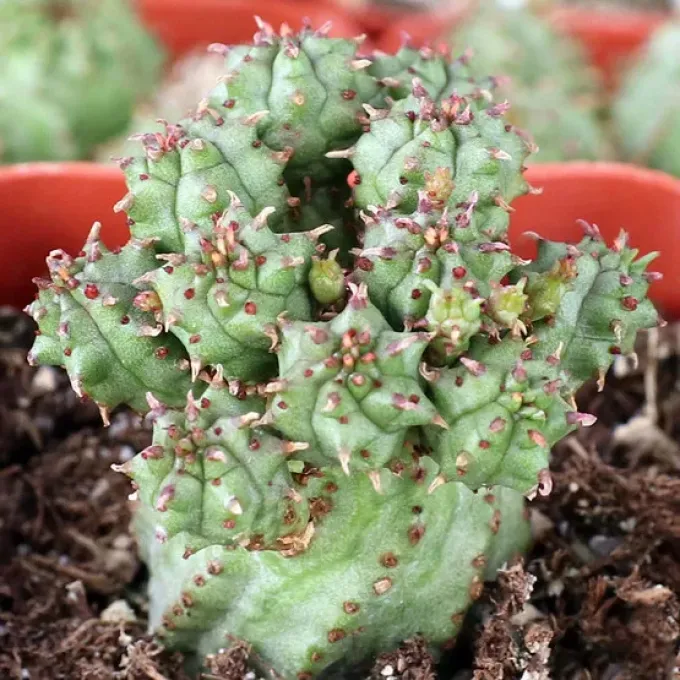
Description
Growing requirements
Euphorbia submamillaris is a perennial succulent belonging to the Euphorbiaceae family. Native to the arid regions of South Africa, this plant has adapted to survive in harsh, desert-like environments, which defines its specialized botanical and agricultural requirements for domestic cultivation.
The plant requires high levels of bright, direct sunlight to maintain its characteristic structure and compact growth. Placing it in low-light environments leads to etiolation, where the stems become stretched and pale, significantly decreasing the aesthetic and biological quality of the specimen.
A well-draining soil medium is the most critical agricultural requirement. It is recommended to use a substrate mixture consisting of coarse sand, perlite, and a small portion of potting soil. This structure prevents moisture retention around the root system, which is vital for preventing physiological stress.
Climate management involves distinct cycles. During the growing season, temperatures between 22 and 28 degrees Celsius are ideal. Conversely, a winter dormant period with temperatures ranging from 12 to 15 degrees Celsius is essential for the health of the plant and future development.
Watering should be approached with caution: only irrigate when the substrate is completely dry. Overwatering is the most common cause of failure in cultivating this species. Fertilization should be kept to a minimum, using balanced, low-nitrogen fertilizers intended specifically for cacti and succulents.
Main diseases and pests
The primary threat to the health of Euphorbia submamillaris is fungal rot, which typically develops due to overwatering or inadequate soil aeration. If signs of softening or discoloration occur at the base of the plant, immediate action, including drying the roots and repotting, is necessary.
Mealybugs are the most persistent pests for this species, as they tend to congregate in the small depressions between the ribs and around the spines. Their presence is indicated by a white, cottony substance. Systemic insecticides are the most effective method for controlling this infestation.
Spider mites can become a problem in environments with low humidity. They damage the plant by feeding on the surface cells of the stem, often leaving small scars or yellow spots. Increasing airflow and using appropriate miticides are standard management practices for this pest.
Scale insects can also infest the succulent stems. They appear as small, hard, brown or black bumps that are difficult to remove without harming the plant. Manual removal with a cotton swab soaked in rubbing alcohol, followed by an insecticidal application, is the recommended control method.
Preventative maintenance includes keeping the plant in a clean environment and ensuring consistent light levels. Strong, healthy plants possess natural defense mechanisms that make them less susceptible to common threats. Regular monitoring of the stem surface is essential for early detection of any issues.