
Seguier's spurge
Euphorbia seguieriana
Description
Growing requirements
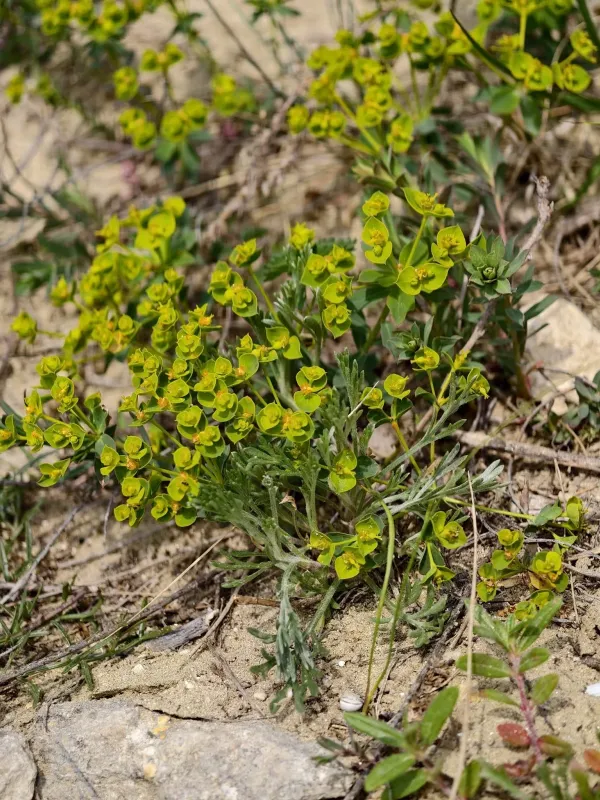
Seguier's spurge (Euphorbia seguieriana) is a perennial herbaceous plant belonging to the Euphorbiaceae family. This species is native to Eurasia and is primarily found in dry steppes, rocky outcrops, and sandy grasslands.
The plant is highly adapted to arid environments, possessing a deep taproot system that facilitates survival in poor, dry, or limestone-rich soils. Its blue-green foliage and compact structure are characteristic of its xerophytic nature, minimizing water loss.
Regarding climate requirements, it thrives in full sun exposure and is highly frost-hardy. It is widely considered an excellent candidate for landscape restoration and stabilizing eroded slopes where irrigation is not feasible or desirable.
Botanically, it typically grows between 20 and 50 cm tall, forming clumps of erect stems. Like other members of its genus, it contains a milky latex in its stems and leaves, which serves as a natural deterrent against various herbivores.
In terms of agricultural and practical use, Seguier's spurge is valued for its role as a honey plant and its potential in pharmacological research due to the presence of terpenoids and other secondary metabolites in its chemical composition.
Main diseases and pests
The primary pathological threats to the crop include various fungal diseases such as powdery mildew, which can develop if the planting site lacks adequate air circulation. Root rot is a significant risk factor if the soil provides poor drainage or remains waterlogged.
Insect pests include aphids and mites, which can infest the succulent growth during extended dry periods. Certain moth larvae, specifically those specialized in Euphorbiaceae, can also cause localized damage to the foliage, necessitating integrated pest management strategies.