
Pink spurge
Euphorbia rosea
Description
Growing requirements
Pink spurge (Euphorbia rosea) is a perennial herbaceous plant belonging to the Euphorbiaceae family. Originating from the tropical regions of South Asia, specifically India and Sri Lanka, it thrives in sandy coastal environments where full sun exposure is constant.
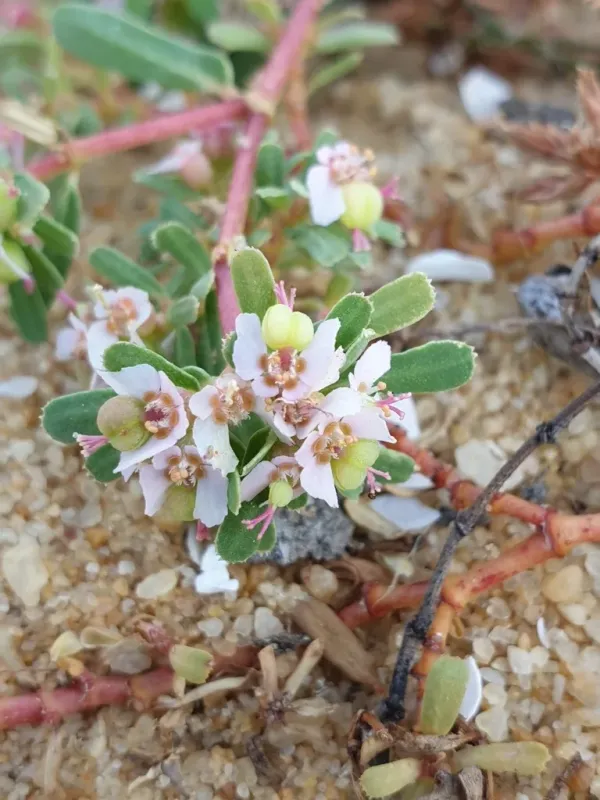
Botanically, it is a prostrate succulent that forms dense mats. Its fleshy, moisture-storing stems are a primary adaptation to arid or semi-arid conditions. The root system is relatively shallow, designed to absorb water quickly from light, sporadic rainfall in permeable soils.
Climate requirements include high ambient temperatures and a lack of frost. The plant is highly sensitive to cold, and temperatures falling below 15 degrees Celsius can trigger metabolic stasis. It requires high light intensity to maintain its compact growth form and prevent etiolation.
Soil management is centered on drainage. In commercial or decorative cultivation, growers must use highly porous substrates, such as sandy loam mixed with volcanic grit. The pH should be neutral to slightly acidic to facilitate optimal nutrient uptake for the Euphorbia genus.
Agronomic practices emphasize minimal watering, allowing the soil to dry out completely between sessions. Excessive moisture is the most common cause of plant failure, leading to rapid tissue decay and eventual death of the succulent structures.
Main diseases and pests
Root rot, driven by Pythium or Phytophthora species, remains the most significant threat to Pink spurge. These fungal pathogens flourish in waterlogged conditions and can destroy a healthy plant within a few days if soil drainage is inadequate.
Pest pressures are primarily from spider mites, which thrive in low-humidity environments, and mealybugs. Mealybugs tend to hide in the tight spaces between stems, making them difficult to detect and control without regular inspections and systemic treatments.
Control strategies involve a combination of environmental adjustment—specifically increasing airflow—and the use of targeted pesticides. Biological control agents may also be used in greenhouse settings to manage populations of sap-sucking insects effectively.
Safety is paramount, as the milky sap produced by the plant contains toxic diterpene esters. Direct exposure to this latex can cause significant skin irritation, allergic reactions, and severe inflammation upon contact with the eyes or mucous membranes.
Proper sanitation tools and protective clothing are essential for any agronomic handling of the crop. Following the harvest or pruning, instruments must be thoroughly cleaned with alcohol to prevent the cross-contamination of potential fungal spores or viruses between plants.