
Resin spurge
Euphorbia resinifera
Description
Growing requirements
Resin spurge (Euphorbia resinifera) is a distinct perennial succulent plant belonging to the Euphorbiaceae family. It is native to the Atlas Mountains of Morocco, where it thrives in rugged, rocky environments under intense heat and periodic drought conditions.
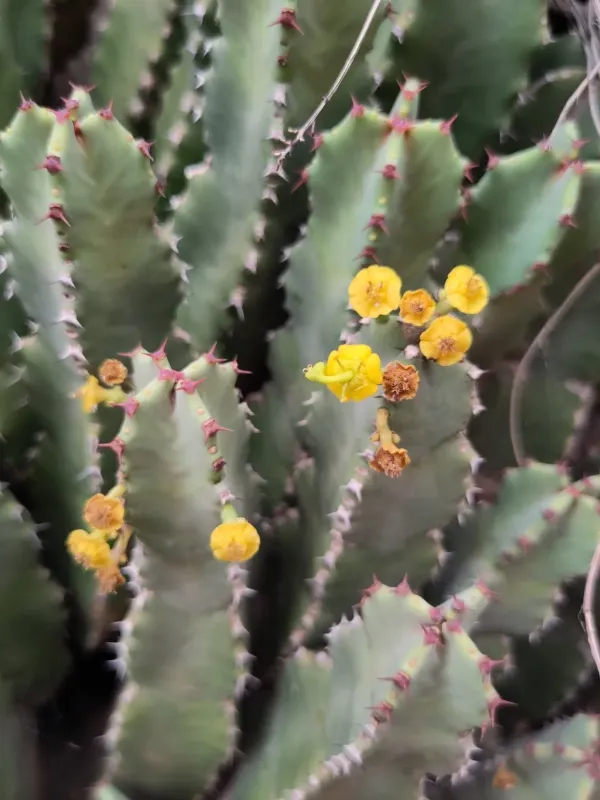
The plant exhibits a unique growth habit, forming dense cushions of four-angled, cactus-like stems. These stems serve as moisture reservoirs, protected by rows of small, sharp spines that reduce surface area and provide defense against herbivores.
Successful cultivation requires a substrate with excellent drainage, typically a mix of grit, sand, and lean soil. It demands a position in full sun to maintain its compact architecture and to prevent the etiolation that occurs in low-light conditions.
Watering requirements are minimal; the plant enters a period of dormancy during the colder months, during which irrigation should be strictly withheld. Proper aeration is crucial to prevent the accumulation of moisture around the base of the stems.
Historically, the latex extracted from the stem, known as euphorbium, has been valued for its medicinal properties, including as a powerful purgative and an ingredient in traditional ointments. Today, it is primarily appreciated by botanical collectors for its striking sculptural form.
Main diseases and pests
The primary threats to the health of Euphorbia resinifera are associated with overwatering and inadequate ventilation, which lead to severe root rot.
Fungal pathogens often colonize the succulent stems when the humidity remains high for extended periods, causing soft, necrotic patches on the stems.
Mealybugs are the most common pest, often embedding themselves between the ridges of the stems where they are protected from topical treatments.
Spider mites can also become problematic in hot, dry greenhouse environments, leading to unsightly scarring on the surface of the plant.
Integrated pest management, including visual inspections and maintaining dry conditions, is the most effective approach to preventing large-scale infestations.