
Baseball plant
Euphorbia obesa
Description
Sowing dates
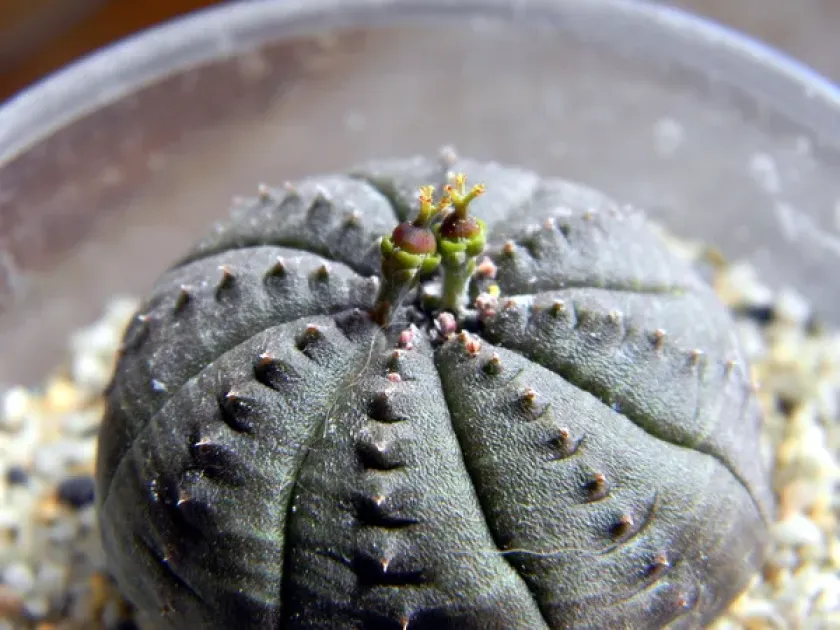
The Baseball plant (Euphorbia obesa) is a distinct member of the Euphorbiaceae family, recognized for its unique spherical, trunk-like body that mimics a baseball.
Propagation is strictly through seeds, as the plant lacks offsets and vegetative propagation is practically impossible without specialized laboratory techniques.
Seeds should be sown in a well-draining, sterile mineral-rich substrate during the early spring to maximize the length of the growing season.
Maintaining high humidity and temperatures between 22–26 degrees Celsius is critical during the initial germination phase of the crop.
Seedlings show a steady, albeit slow, growth pattern, requiring minimal disturbance until they achieve a stable globular structure.
Growing requirements
This succulent requires extremely porous soil, usually consisting of equal parts of coarse sand, pumice, and low-nutrient loam to ensure drainage.
Direct exposure to bright sunlight is essential for the plant to maintain its characteristic compact shape and vibrant coloration.
Watering protocols must be strict: only water the plant when the soil is completely desiccated to prevent the internal tissues from rotting.
During the dormant winter phase, the plant should remain completely dry in a cool environment, ideally between 10 and 15 degrees Celsius.
Good air circulation is necessary to simulate the arid conditions of its native habitat and to strengthen the plant's cuticle layer.
Main diseases and pests
Root rot is the most significant threat to Euphorbia obesa, usually caused by overwatering or soil that retains moisture for too long.
Mealybugs are the primary pests that tend to infest the plant, residing in the small cavities on the stem and causing localized tissue damage.
Spider mites can also become a problem if the plant is kept in low humidity and stagnant air environments for extended periods.
Chemical control should be limited to specific pesticides labeled safe for succulents, as the plant's skin can be sensitive to concentrated oils.
Early detection of soft spots on the stem is vital, as this is often the first visual indication of systemic fungal infection.