
Euphorbia brevirama
Euphorbia brevirama
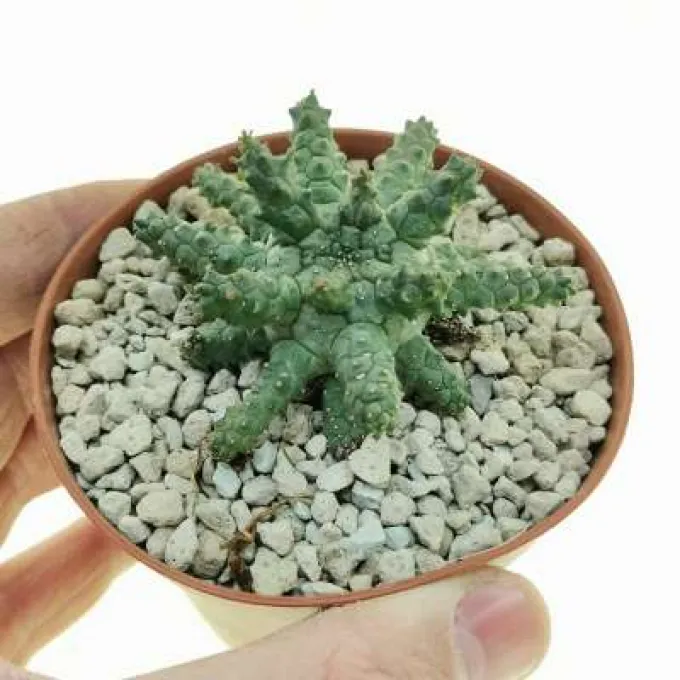
Description
Growing requirements
Euphorbia brevirama is a dwarf succulent shrub belonging to the Euphorbiaceae family. It is distinguished by its short, thick branches, which serve as water-storage organs, allowing the plant to thrive in harsh, arid environments.
Originating from the arid regions of Southern Africa, this species is highly adapted to rocky, nutrient-poor substrates. Its evolutionary success depends on its ability to withstand extreme water scarcity and high solar radiation levels.
In terms of agricultural and horticultural requirements, this species demands excellent drainage. The soil medium must be highly porous; sandy or grit-based mixes are essential to prevent the accumulation of moisture around the roots.
The plant thrives in bright, direct sunlight. When cultivated in controlled environments, it requires optimal light exposure to maintain its characteristic compact morphology. Insufficient light leads to etiolation, which compromises the physical integrity of the stem.
Economically, Euphorbia brevirama is primarily valued as a specialized horticultural crop for rock gardens and succulent collections. Its unique biological structure and resilience make it a sought-after species for xeriscaping projects.
Main diseases and pests
The primary threats to Euphorbia brevirama are root and stem rots caused by over-irrigation or high humidity levels coupled with poor air circulation. These conditions create a favorable environment for opportunistic pathogens.
Pests such as mealybugs and spider mites are frequent adversaries in cultivation. They tend to hide in the tight branch junctions, making them difficult to eradicate without a systematic approach to pest management.
Preventative measures are essential for the health of this culture. Ensuring that the substrate dries out completely between waterings is the most effective way to avoid fungal infections and root suffocation.
Chemical control should be approached with caution. Many succulent species have sensitive surfaces that may react negatively to solvent-based pesticides, therefore, oil-free formulations are highly recommended.
Regular monitoring of the plant’s base and branch axils is critical for early intervention. Maintaining a hygienic environment and ensuring proper spacing between plants significantly reduces the risk of pest infestation and disease transmission.