
Mexican erythrina
Erythrina mexicana
Description
Growing requirements
Mexican erythrina (Erythrina mexicana) is a perennial deciduous tree within the Fabaceae family. Native to the varied landscapes of Mexico, it has become a significant specimen in agroforestry due to its biological nitrogen-fixing properties and its architectural role in tropical planting schemes.
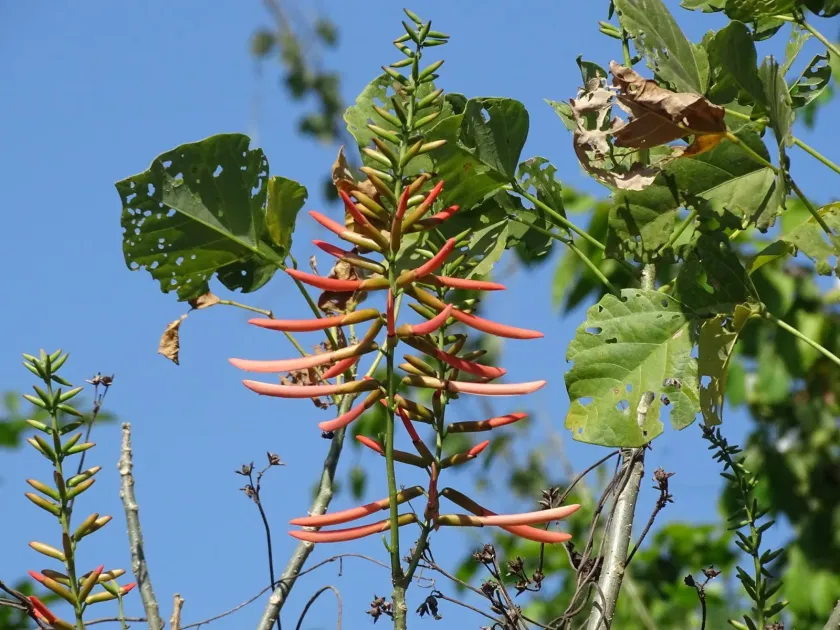
The plant features distinctively prickly trunks and branches, along with striking scarlet flowers that emerge on bare wood. This species has evolved to thrive in environments where seasonal variations in rainfall dictate the biological rhythm of the tree, primarily shedding its leaves during the dry season.
Optimal growth conditions require full sun exposure and well-drained soil substrates. Unlike many other tree species, Mexican erythrina is highly adaptable to various soil types, though it performs most reliably in loamy soils with adequate aeration to support its deep and complex root structure.
Climate requirements remain the primary limiting factor for wider adoption, as the species is strictly adapted to frost-free environments. In areas susceptible to frost, protection or greenhouse cultivation is mandatory, as the woody tissue is highly sensitive to freezing temperatures.
Field management focuses primarily on pruning, which is essential for maintaining tree health and aesthetic form. Controlled pruning not only facilitates harvest access to floral parts in certain applications but also encourages the development of a more robust, bushy canopy structure.
Main diseases and pests
The species is frequently challenged by defoliating insects that can cause significant damage to the canopy during the peak growing season. Regular visual inspection is recommended to identify localized infestations before they expand to the entire stand, ensuring tree vitality.
Root rot pathogens represent the most significant threat to the survival of Erythrina mexicana in cultivation. These are typically associated with poor drainage conditions and compacted soils, which prevent adequate root respiration and create ideal environments for soil-borne fungal growth.