
Spiny emex
Emex australis Steinh.
Description
Growing requirements
Spiny emex is a herbaceous annual plant belonging to the Polygonaceae family. In agricultural contexts, it is widely recognized as a problematic and invasive weed that poses significant challenges to crop production and pasture management.
Originating from Southern Africa, the plant has successfully colonized various regions across the globe, including Australia and parts of the Americas. It thrives in light-textured soils, particularly sandy or loamy types, and is often found in disturbed environments.
The plant exhibits a prostrate growth habit with branched stems and a deep taproot that allows it to survive in arid conditions. This root system is highly efficient at extracting limited moisture, often outcompeting crop seedlings.
It prefers climates with mild, wet winters and hot, dry summers, mirroring its native South African range. Its ability to tolerate salinity and a wide range of temperatures contributes to its status as a highly successful invasive species.
From an agricultural standpoint, Spiny emex provides no economic value. It is considered a major pest in both cultivation fields and grazing lands due to its aggressive spread and its negative impact on livestock welfare.
Main diseases and pests
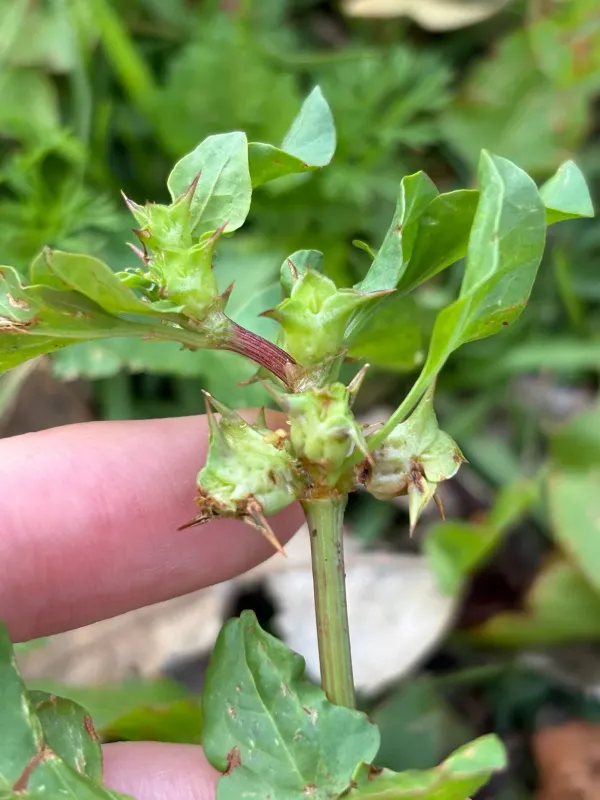
The primary threat posed by this plant is its seed production mechanism. The spiny burrs can easily attach to animal coats and machinery tires, facilitating rapid dispersal across vast distances and ensuring the infestation of new areas.
Spiny emex is a fierce competitor in agricultural fields, rapidly occupying space and consuming resources before the main crop can establish itself. This competition frequently results in significant yield losses in cereals and pulse crops.
Management of the weed is hindered by its strong resistance to several common herbicides. This has forced farmers to integrate mechanical control measures, such as deep tillage, with chemical rotation programs to prevent total crop loss.
The physical hazards of the spiny burrs are significant, as they can cause lameness in livestock by embedding in hooves or skin. This reduces the overall efficiency of grazing systems and necessitates additional veterinary care.
While various biocontrol agents, including specific weevils, have been introduced in certain regions to suppress Spiny emex, the species remains resilient due to its massive and long-lasting soil seed bank.