
Canadian waterweed
Elodea canadensis Michx.
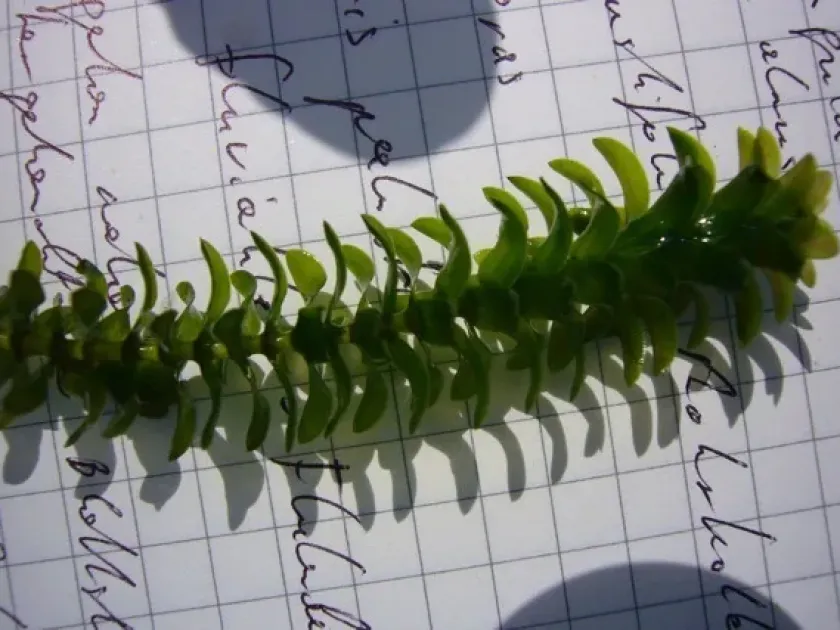
Description
Growing requirements
Elodea canadensis, commonly known as Canadian waterweed, is a perennial aquatic plant belonging to the Hydrocharitaceae family. It is a submerged macrophyte that thrives in freshwater habitats, often forming dense underwater colonies that dominate the aquatic vegetation.
Native to North America, it has been introduced to various parts of the world. Its ability to propagate vegetatively from small stem fragments has contributed to its widespread distribution across different continents and climates.
The plant requires stagnant or slow-moving water and favors nutrient-rich environments. It is highly adaptable to various water depths, provided that sunlight can penetrate the water column to support photosynthesis.
Soil requirements are minimal, as the roots mainly serve as anchors. The plant absorbs essential nutrients directly through its leaves and stems from the water column, making it highly efficient in extracting dissolved inorganic substances.
Optimal growth occurs at water temperatures ranging from 15 to 25 degrees Celsius. It is sensitive to water transparency; turbid water reduces its photosynthetic rate, limiting its expansion in deeper areas of the water body.
Yield
In aquaculture and water management, Elodea canadensis is valued for its potential in bioremediation. It effectively removes excess nitrogen, phosphorus, and heavy metals from water, helping to prevent the eutrophication of ponds and small lakes.
The biomass generated by the plant can be utilized as a natural fertilizer. Due to its high mineral content, it serves as a valuable supplement for compost, enhancing soil fertility when applied in agricultural settings.
Research suggests that processed Elodea biomass may have applications as a feed ingredient for livestock, provided that moisture content is reduced. However, its primary agricultural role remains centered on aquatic system maintenance and oxygen production.
The yield of Canadian waterweed is remarkably high, as it can double its biomass in a matter of weeks under ideal conditions. This makes it a productive source of biomass for various environmental improvement projects.
Management of the yield is critical to prevent it from becoming a nuisance. Mechanical harvesting using specialized aquatic weed cutters is the standard approach to prevent overgrowth that could interfere with irrigation and water transport systems.
Main diseases and pests
Elodea canadensis is generally robust against most plant diseases. However, in stagnant and highly polluted waters, it can be susceptible to fungal infections that cause tissue decay, potentially leading to oxygen depletion as the plant mass decomposes.
While the plant has few specific insect pests, aquatic snails and certain species of water fowl can graze on its shoots, reducing its overall density. These natural controllers are rarely sufficient to manage aggressive growth in optimal conditions.
The greatest threat associated with this plant is its invasive nature. By forming dense mats, it competes with native aquatic species for space, nutrients, and sunlight, often leading to a loss of biodiversity in the affected water bodies.
Biological control, particularly the introduction of grass carp (Ctenopharyngodon idella), is one of the most effective methods for managing Elodea populations in controlled environments like fish farms and artificial reservoirs.
Integrated management plans are necessary to mitigate risks. These include regular surveillance, limiting the transfer of plant fragments between disconnected water bodies, and using chemical controls only as a last resort due to their impact on water quality.