
Hedgehog grass
Echinaria capitata
Description
Growing requirements
Hedgehog grass (Echinaria capitata) is an annual herbaceous plant belonging to the Poaceae family. In an agricultural context, this species is primarily recognized as a component of natural pastures and grassland communities.
The plant has a broad natural range, spanning across the Mediterranean basin, Southern Europe, the Caucasus, and Western Asia. It thrives in open, sunny environments and is typically found in arid habitats, rocky slopes, and semi-desert landscapes.
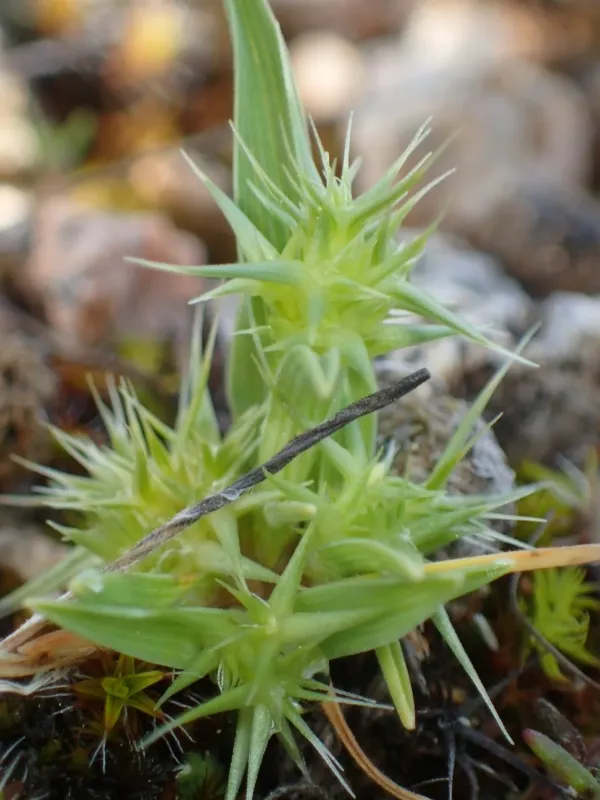
Botanically, the plant is characterized by its distinct, capitate spike-like inflorescence covered with sharp, bristly scales, which explains its common name. The stems are generally short, reaching between 10 and 30 centimeters, often growing in compact tufts with narrow basal leaves.
This grass is highly adapted to drought conditions, making it resilient in regions with limited rainfall. It has low soil requirements, thriving best in well-drained, sandy or gravelly soils with a neutral to slightly alkaline pH level.
While not typically grown as a dedicated monocrop, it serves as an important forage resource for sheep and goats. Its value is highest during the early spring season, before the plant matures and becomes too lignified and bristly for effective grazing.
Main diseases and pests
Like many wild grass species, Hedgehog grass can occasionally suffer from rust fungi in environments with excessive moisture. However, due to its adaptation to dry habitats, it generally remains resilient to widespread fungal outbreaks under standard climatic conditions.
Primary pests include various cereal-feeding insects and aphids that target the succulent young shoots. Damage caused by these pests in the spring can potentially reduce the overall biomass available for grazing livestock.
Cereal fly larvae also represent a potential threat, as they can cause damage to the stem base. This risk is notably higher in areas subjected to overgrazing, where the soil integrity is compromised and the plants are under stress.
To mitigate these threats, it is essential to manage grazing intensity carefully. Preserving biodiversity within pasture lands encourages the presence of natural predators that help regulate pest populations effectively.
Despite being susceptible to certain pests, Echinaria capitata possesses a strong capacity for recovery. Its evolutionary adaptation to harsh environments allows it to maintain its role as a stable forage source despite periodic pressure from insects or environmental stressors.