
Desmococcus olivaceus
Desmococcus olivaceum
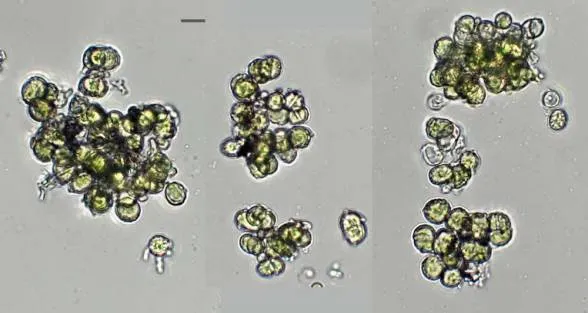
Description
Growing requirements
Desmococcus olivaceus is a unicellular or colonial green alga belonging to the Chlorococcaceae family. It is not an agricultural crop but is a ubiquitous organism commonly found on the bark of trees, stone surfaces, and man-made structures.
The global distribution of this alga is extensive, as it can adapt to various climates. It thrives best in humid and partially shaded environments, often forming a characteristic green film on the northern or protected sides of tree trunks.
Regarding its ecological requirements, Desmococcus olivaceus relies primarily on moisture from the atmosphere. It lacks roots and obtains all necessary nutrients from rain and dust particles deposited on the surface of its host substrate.
This alga is highly resilient to temperature fluctuations. It remains dormant during dry periods, effectively surviving extreme conditions by reducing its metabolic rate until favorable humidity levels return.
There is no industrial cultivation of this species as it is a wild-growing organism. Its primary ecological role involves participating in the initial colonization of bare surfaces and contributing to the biodiversity of tree-surface micro-ecosystems.
Main diseases and pests
The primary threat to the survival of Desmococcus olivaceus is sustained desiccation. When the moisture content of its environment drops below a critical threshold for an extended period, the photosynthetic efficiency collapses.
Air pollution acts as a major environmental stressor. As an epiphytic organism exposed to the atmosphere, it is highly vulnerable to acidic gases and heavy metals, which often inhibit the growth of the green colonies.
Competition from other epiphytes, such as lichens and bryophytes, poses a constant threat. These organisms can outcompete the algae for space and light, eventually displacing the colonies from the bark.
Microscopic pathogens, including certain types of fungi, can infect the algae colonies. These biological threats lead to the degradation of the cell structures and the overall reduction of the colonized area.
Human activities, such as the chemical cleaning of trees or the application of broad-spectrum pesticides, can inadvertently eliminate populations of these beneficial algae. Maintaining a stable environment is essential for their persistence.