
Dendrophthora mancinella
Dendrophthora mancinella
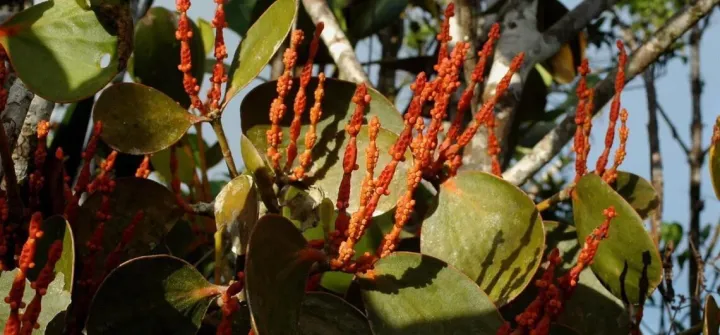
Description
Growing requirements
Dendrophthora mancinella is a member of the Santalaceae family, known for its parasitic lifestyle as an epiphyte on trees. It is not considered an agricultural crop, as its ecological niche is strictly confined to tropical tree canopies where it acts as a hemiparasite.
Native to the tropical regions of the Americas, this species has evolved specialized structures called haustoria. These allow the plant to penetrate the bark of a host tree and siphon water and nutrients directly from the xylem, bypassing the need for soil cultivation.
The climate requirements for this plant are centered on tropical stability. It thrives in environments with high humidity and consistent, warm temperatures throughout the year, failing to survive in regions with significant temperature fluctuations or prolonged dry spells.
There are no agricultural practices associated with this plant, as it cannot be grown in standard farming conditions. Its life cycle is entirely dependent on host availability and avian dispersal agents that transport seeds to suitable branches.
Botanically, the plant presents as a small, shrubby growth with simple, opposite leaves. Its flowers are generally inconspicuous and arranged in spikes, typical of the broader Santalaceae family group found in the neotropics.
Main diseases and pests
The primary threat to the stability of Dendrophthora mancinella populations is habitat loss caused by deforestation, which removes the host trees necessary for its survival.
Fungal pathogens often impact these plants when microclimatic conditions in the forest canopy become excessively moist or stagnant.
Competition for light and space with other epiphytic plants can limit its ability to establish on new hosts within dense tropical forests.
Various insect pests can damage the foliage and stems of the parasite, directly affecting its growth rate and reproduction capability.
The decline of specific bird species that act as seed dispersers poses a long-term threat to the colonization of new trees and the genetic health of the population.