
Cornulaca monacantha
Cornulaca monacantha
Description
Sowing dates
Cornulaca monacantha is primarily a wild-growing species, and its propagation in arid regions relies mostly on natural seed dispersal mechanisms.
In restoration projects for degraded desert pastures, seeds are typically sown in late winter or early spring to take advantage of seasonal soil moisture.
The seeds are shallowly sown at a depth of 1 to 2 centimeters, ensuring they are protected from wind erosion while remaining close enough to the surface to germinate.
The success of the sowing process depends on minimal site disturbance, preserving the soil crust which protects the emerging seedlings from extreme heat.
Due to its specialized adaptation, no significant irrigation or chemical input is required during the establishment phase, making it a low-input crop.
Growing requirements
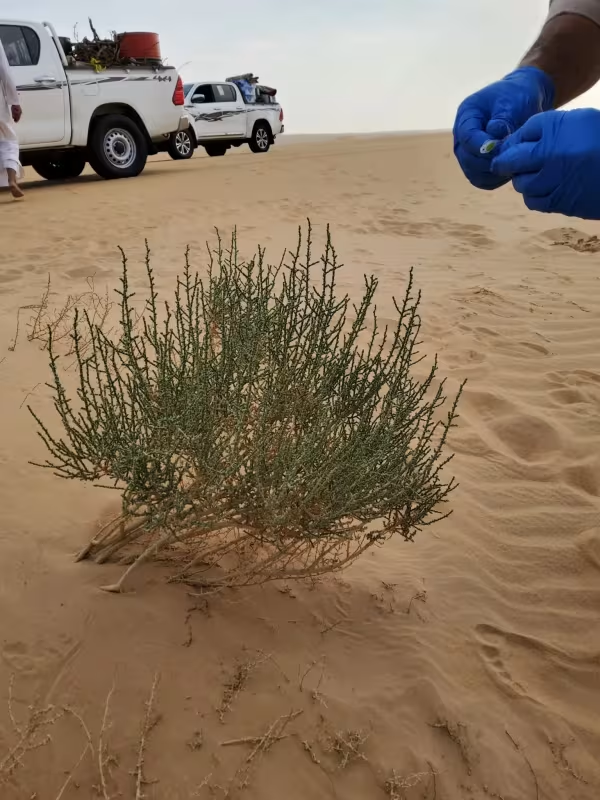
This species belongs to the Amaranthaceae family and is a stiff, intricately branched small shrub typically reaching 30 to 50 centimeters in height.
It is natively distributed across the sandy deserts of North Africa and the Middle East, thriving in environments with extremely low and unpredictable rainfall.
Cornulaca monacantha is highly halophytic, meaning it can tolerate high levels of soil salinity that would be detrimental to most standard agricultural plants.
The plant possesses a deep and highly efficient root system that allows it to access sub-surface water in sandy substrates, ensuring survival through long droughts.
It requires intense solar radiation to maintain its metabolic functions, showing optimal growth under high temperature and arid atmospheric conditions.
Yield
The primary economic value of this plant is as a crucial forage source, particularly for camels, which are the main consumers of its biomass in harsh desert regions.
The forage remains nutritious even during the winter season when other desert grasses become dormant or disappear, providing vital sustenance for nomadic livestock.
Yield metrics are largely dependent on local precipitation patterns, but the species remains reliable as a consistent source of fiber and nutrients in arid zones.
Besides its fodder value, it serves as an essential sand-stabilizing agent, contributing to the health of the entire desert ecosystem by preventing soil erosion.
Sustainable harvesting involves controlled grazing patterns, which allow the plant to maintain its biomass density throughout the year without reaching total depletion.
Main diseases and pests
The main threat to Cornulaca monacantha is overgrazing, which inhibits the plant's ability to produce seeds and results in the degradation of its natural habitat.
Mechanical damage to the fragile desert soil crust, caused by heavy machinery or uncontrolled off-road activities, often leads to the destruction of root systems.
While the species is resistant to most diseases, rare fungal infections can occur during unexpected and prolonged periods of high humidity and soil moisture.
Specific desert-adapted insect pests can cause damage to the succulent young shoots, although these occurrences rarely reach economic or ecological significance.
Effective management requires long-term monitoring of livestock density on desert rangelands to prevent permanent loss of this drought-hardy vegetation.