
Taro
Colocasia esculenta x Leucocasia gigantea
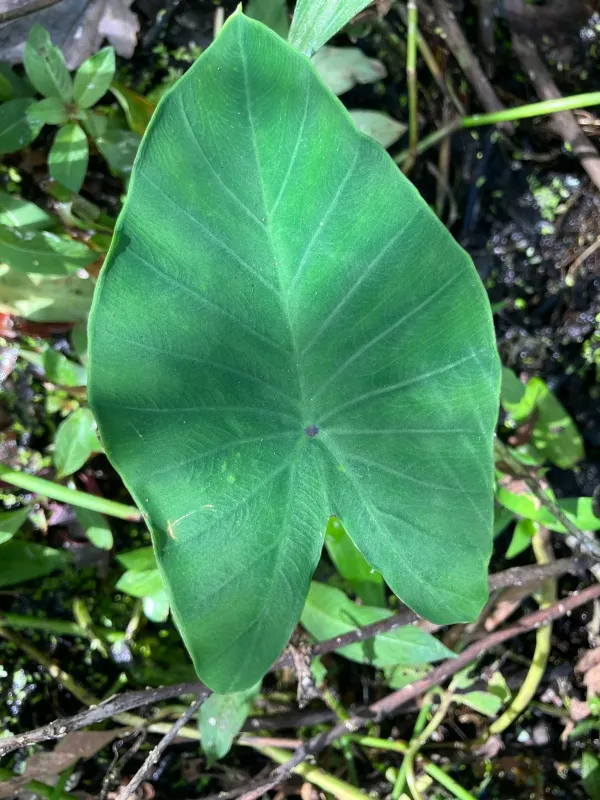
Description
Sowing dates
Taro (Colocasia esculenta x Leucocasia gigantea) is best planted at the onset of the rainy season in tropical environments to ensure adequate water availability for root establishment. In temperate climates, planting should only begin once soil temperatures consistently exceed 18°C.
The planting material consists of small whole tubers or segments of larger rhizomes containing active buds. These are buried at a depth of 10–15 cm to protect the buds from environmental stress while ensuring they reach moist soil layers.
Spacing is critical for yield optimization; a distance of 80–100 cm between rows is recommended to allow the large, heart-shaped leaves to receive sufficient sunlight and to provide necessary airflow across the plantation.
The growth cycle spans 6 to 9 months depending on the cultivar. Early-maturing varieties are preferred in areas where the frost-free season is shorter, allowing for harvest before the onset of cold weather.
Pre-conditioning the planting material in high-humidity conditions helps speed up germination. This process allows farmers to identify and discard weak or diseased tubers before they are introduced into the field, improving overall stand uniformity.
Growing requirements
As a member of the Araceae family, taro is a tropical perennial that thrives in warm, humid climates with temperatures ranging from 25°C to 30°C. It is extremely sensitive to freezing, which destroys the succulent foliage.
The crop requires deep, fertile, well-draining loamy soils rich in organic matter. A pH level between 5.5 and 7.0 is ideal for maximizing nutrient uptake and supporting the development of healthy, plump tubers.
Water management is the most critical aspect of taro production. The plant is well-adapted to high soil moisture and can withstand waterlogging, making it suitable for wet cultivation areas or irrigated basins.
Taro performs best in high light conditions but can tolerate partial shade. This flexibility allows for its incorporation into diverse agroforestry systems, provided that water and nutrient demands are strictly satisfied.
Nutrient management focuses on nitrogen and potassium, which are essential for producing the expansive leaf canopy and high-starch tubers. Regular application of organic compost significantly enhances soil structure and yield capacity.
Yield
Taro yield depends heavily on the intensity of farm management and the choice of cultivar. With optimized conditions, yields can reach between 15 and 25 metric tons per hectare under intensive commercial production.
Both the main central tuber and secondary cormels contribute to total harvest weight. Productivity is often evaluated based on the uniformity of the tubers and their starch content, which is prioritized by food processing markets.
Early-stage weed management is vital for high yields. Because taro grows relatively slowly during the first few weeks, it is highly vulnerable to competition from invasive weeds for water and space.
Mechanical harvesting and localized irrigation systems can significantly increase net output by reducing damage to the tubers during extraction and maintaining consistent growth rates throughout the hot season.
Regular yield assessments through sample harvesting allow farmers to monitor crop progress and determine the exact timing for the full-scale harvest, ensuring the tubers reach their maximum market potential.
Main diseases and pests
The most devastating disease affecting taro is leaf blight (Phytophthora colocasiae), which causes rapid development of necrotic lesions on the leaves. If untreated, it can reduce photosynthetic capacity and overall tuber development.
Tuber rot, often caused by complex bacterial infections (such as Erwinia) or fungi like Sclerotium rolfsii, is common in poorly drained soils. Maintaining proper field drainage is the primary defense strategy against these pathogens.
Insect pests, including spider mites, aphids, and root-knot nematodes, can severely weaken the plant. Besides direct feeding damage, these pests serve as vectors for viral pathogens that cause stunted growth and yield loss.
An integrated pest management (IPM) approach is recommended, focusing on the use of disease-free planting material, crop rotation, and the judicious use of biopesticides. Constant field monitoring is required during peak growing months.
Chemical control should be used as a last resort, following strict safety guidelines to avoid residues in the edible parts of the plant. Biological controls, such as beneficial predators, are becoming increasingly popular in sustainable taro production.
Harvesting
Harvesting usually commences when the foliage begins to show yellowing and senescence, signaling that the plant has completed its vegetative phase and transferred its energy reserves to the tubers.
Tubers are carefully lifted from the soil to avoid wounding, as cuts and bruises provide entry points for storage pathogens. Manual harvesting is standard in small-scale plots, while mechanical diggers are used in larger commercial farms.
Post-harvest curing is essential; tubers should be kept in a shaded, well-ventilated area for several days to harden the skin. This step is crucial for increasing the shelf life and preventing spoilage during transport.
Storage should occur in a cool, dry environment with moderate humidity to prevent both dehydration and premature sprouting. Proper ventilation is key to maintaining high quality for up to several months.
Grading of the harvest based on size and physical integrity ensures that the best tubers reach the consumer, while smaller or lower-quality tubers can be recycled as animal feed or processed for starch extraction.