
Borrichia frutescens
Borrichia frutescens
Description
Growing requirements
Borrichia frutescens, commonly known as sea oxeye daisy, is a woody perennial subshrub belonging to the Asteraceae family. It is native to the coastal regions of the southeastern United States, Bermuda, and parts of the Caribbean.
As a true halophyte, this species thrives in saline environments such as salt marshes and coastal dunes. It exhibits significant physiological adaptations, including salt-secreting glands, which allow it to maintain homeostasis despite high levels of sodium.
The plant requires full sun exposure to flourish. It is highly drought-tolerant once established and possesses an extensive root system that helps it survive in nutrient-poor, sandy, or muddy maritime soils.
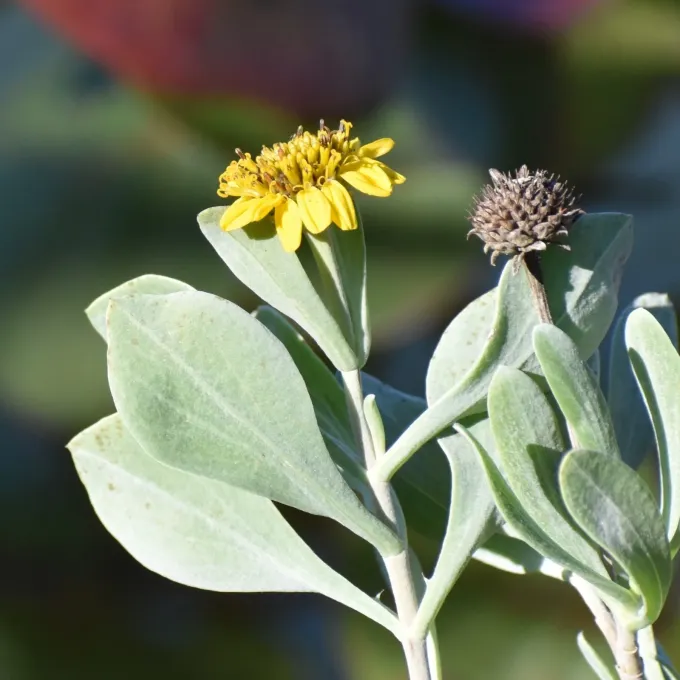
Botanically, the species is identified by its fleshy, opposite, grey-green leaves covered in fine hairs. These trichomes serve as an evolutionary mechanism to reflect excess sunlight and reduce transpiration in harsh coastal environments.
Blooming occurs primarily from spring through summer, producing yellow, daisy-like flowers. These flowers are vital for local pollinators, including bees and butterflies, which are attracted to the nectar-rich florets in otherwise sparse coastal habitats.
Harvesting
The primary agricultural and environmental use of Borrichia frutescens is coastal erosion control. Due to its dense growth habit and strong roots, it is widely utilized for stabilizing shorelines and protecting against storm surges.
In landscaping, it is favored for salt-spray tolerant gardening. It creates low-maintenance borders that provide seasonal color without the need for intensive irrigation, making it a sustainable choice for beach-front properties.
Propagation is typically done through seed collection in late summer or by stem cuttings. Seeds should be sown in a well-drained, slightly saline medium to encourage germination and mimic natural habitat conditions.
There is ongoing interest in the plant's potential for phytoremediation, specifically its ability to stabilize heavy metals and manage mineral accumulation in coastal wetlands and brownfield restoration projects.
While not a major food crop, the plant plays a crucial role in local ecology. Its presence facilitates the colonization of other native species, acting as a pioneer plant in the process of ecological succession on reclaimed lands.