
American sloughgrass
Beckmannia eruciformis (L.) Host
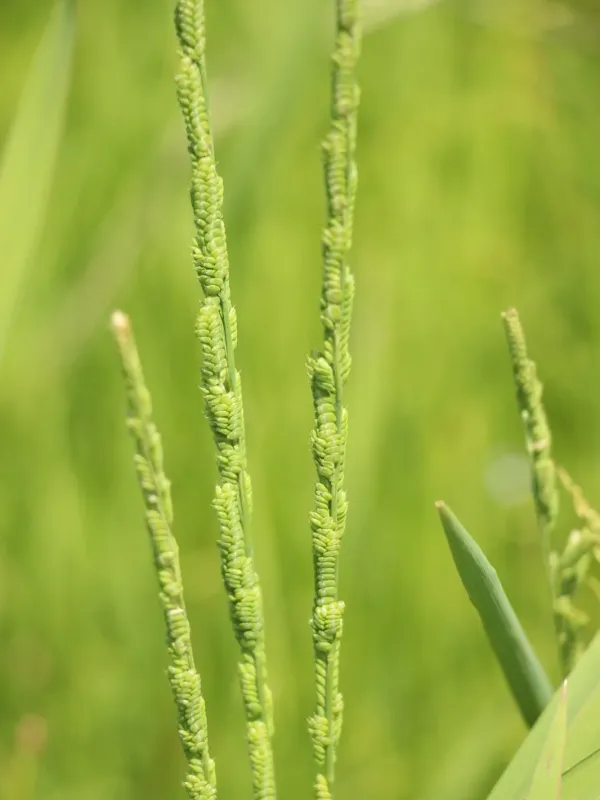
Description
Sowing dates
Beckmannia eruciformis, commonly known as American sloughgrass, is a moisture-loving perennial grass belonging to the Poaceae family. Sowing should ideally be performed in early spring when the soil is moisture-rich from snowmelt, which ensures high germination rates.
When sown in late autumn, the seeds undergo natural stratification, which promotes uniform emergence in the spring. Quality seedbed preparation is critical because the seeds are relatively small and require good soil contact.
The sowing depth should be maintained between 1–2 cm, depending on the soil structure. Planting too deep significantly reduces seedling vigor, as the young sprouts have limited energy to emerge through thick layers of soil.
The recommended seeding rate for pure stands is approximately 10–12 kg per hectare. When included in grass mixtures, the rate is adjusted based on the competitive nature and composition of other species in the field.
Rolling the field after sowing is an essential step to ensure firm soil-to-seed contact. This practice significantly improves overall germination and helps achieve an even distribution of the crop across the field.
Growing requirements
This crop is highly demanding regarding water availability, preferring low-lying, periodically flooded areas. It is uniquely adapted to survive submersion by floodwaters for 30–45 days without sustaining significant damage to its vegetative growth.
Optimal productivity is achieved on alluvial, meadow-chernozem, and peaty soils. In contrast, the grass performs poorly and quickly disappears from the sward if grown on dry, sandy, or highly saline soils.
The species is remarkably cold-hardy and winter-resistant, making it suitable for regions with harsh climatic conditions. It exhibits excellent tolerance to spring frosts common in northern temperate latitudes.
For high performance, the crop requires adequate nitrogen availability. Regular fertilization in the second and subsequent years of development is essential to encourage intense tillering and maintain a dense, productive stand.
It displays high ecological plasticity in floodplain ecosystems, where it successfully competes with other moisture-tolerant grasses, occupying a stable niche in natural temperate plant communities.
Yield
Under favorable moisture conditions, the green mass yield of Beckmannia eruciformis can reach 150–250 centners per hectare. When managed for hay, producers can expect a yield of 40–60 centners of high-quality fodder.
Seed harvesting presents certain challenges due to the uneven ripening of the inflorescences. Seed fields must be carefully monitored, as excessive delay leads to heavy shattering of the grains, which drastically reduces the harvest yield.
After the first cut, the crop is capable of producing vigorous regrowth (aftermath), especially if the summer season maintains high levels of soil moisture. This makes it a valuable component in multi-purpose grazing and hay systems.
Biological productivity remains stable for 5–7 years with proper maintenance. After this period, natural aging of the stand begins, leading to a gradual decline in both biomass volume and the nutritional quality of the forage.
Nutritionally, this grass is prized for its high protein content and palatability. In the heading stage, it contains a balanced profile of essential amino acids required for the healthy development of ruminant livestock.
Main diseases and pests
American sloughgrass exhibits high resistance to the major fungal diseases common to meadow grasses. Rare instances of powdery mildew or rust typically occur only when basic agronomic standards are ignored.
The most significant pests are cereal flies and stem fleas. During years of massive outbreaks, these insects can damage young shoots, which slows down crop development significantly during the critical spring growth phase.
For seed production fields, approved insecticides may be applied during the growing season to mitigate damage. In forage meadows, chemical control is rarely used, with producers favoring cultural control methods to manage pest populations.
An important aspect of crop protection is preventing weed competition during the early establishment phase. Since growth is slow initially, early harrowing is crucial to give the grass an advantage over invasive weeds.
Damage to the root system by small rodents, such as voles, can occur during the winter, particularly when the field has a thick snow cover. In such cases, rodent control measures may be necessary to preserve the stand density.
Harvesting
Harvesting for hay should ideally take place during the heading to early flowering stage. This timing captures the optimal balance between the total volume of biomass and its nutritional density.
Delaying the harvest results in a rapid decline in quality due to the accumulation of structural fiber. The stems become coarse, which decreases palatability and lowers the digestibility of nutrients for livestock.
The preferred method is a single-phase harvest followed by wilting in windrows. Due to the high moisture content of the stems, active tedding is necessary to accelerate drying and prevent decay within the center of the windrow.
For seed production, harvesting is performed either in two stages or by direct combining when the lower part of the panicles turns brown. This minimizes shattering losses, which are a characteristic trait of this grass species.
After the hay harvest, light harrowing is recommended to remove dead plant debris. This simple operation stimulates the growth of new shoots and helps maintain the overall productivity of the meadow for subsequent seasons.