
Northern bayberry
Morella pensylvanica (Mirb.) Kartesz
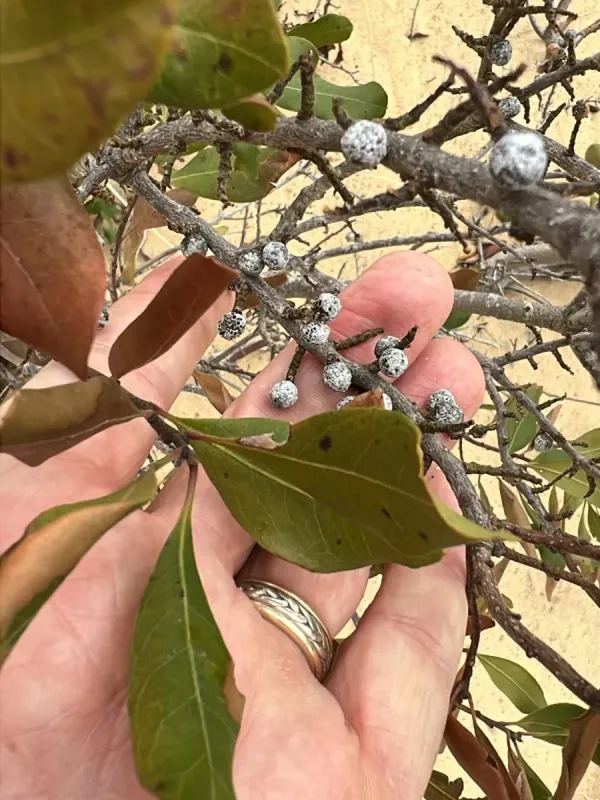
Description
Growing requirements
Northern bayberry (Morella pensylvanica) is a hardy shrub belonging to the Myricaceae family. It is native to the eastern regions of North America, where it typically thrives in coastal, sandy, and nutrient-poor soils.
One of the most notable biological traits of this shrub is its nitrogen-fixing capability. Thanks to a symbiotic relationship with specific soil bacteria, it can flourish in environments where nitrogen levels are insufficient for other plants.
The plant requires full sun to partial shade and prefers acidic, well-draining soil. It is exceptionally tolerant of salt spray and strong winds, making it a staple for seaside landscaping and soil stabilization.
Regarding climate, Northern bayberry is highly adaptable and frost-hardy. It thrives in temperate regions and remains evergreen or semi-evergreen depending on the severity of the winter temperatures.
Propagation is typically achieved through seeds, cuttings, or by transplanting suckers that develop from the extensive root system. Mulching with pine needles helps maintain the required soil acidity for optimal health.
Yield
The primary economic use of Northern bayberry is the extraction of aromatic wax from its greyish berries. This wax has been historically harvested to produce high-quality, long-burning, and fragrant candles.
The leaves are highly aromatic and are used in culinary applications. They provide a unique, savory flavor profile when added to soups, stews, and roasted meats, often used as a substitute for bay laurel.
In agriculture, it serves as a valuable plant for land reclamation. Its ability to enrich the soil with nitrogen and its strong root system make it a premier choice for controlling soil erosion.
Wildlife support is another major role of this crop. Its berries provide critical winter fuel for various bird species, helping maintain local biodiversity in rural and coastal landscapes.
While not a traditional large-scale cash crop, it offers excellent potential for small-batch specialty production, particularly in the niche markets of natural candle making and gourmet spice herbs.
Main diseases and pests
Northern bayberry is highly resistant to most pests and diseases. The most significant threat is root rot, which typically occurs in soils that retain too much moisture and lack adequate drainage.
Iron chlorosis may appear if the soil pH is too high. This condition manifests as yellowing of the leaves and can be treated by applying sulfur or other acidifying agents to lower the pH to the preferred range.
Occasional infestations of aphids can occur during the spring months. These are usually not economically devastating and can be managed using simple physical removal or insecticidal soap sprays.
Fungal leaf spots can develop in environments with poor air circulation. Proper spacing between plants and regular pruning of dead or crossing branches help to significantly reduce this risk.
Overall, the plant is remarkably robust. Due to its natural resistance, it requires very little intervention, making it a low-maintenance option for both professional nurseries and home gardens.