
Azima tetracantha
Azima tetracantha
Description
Growing requirements
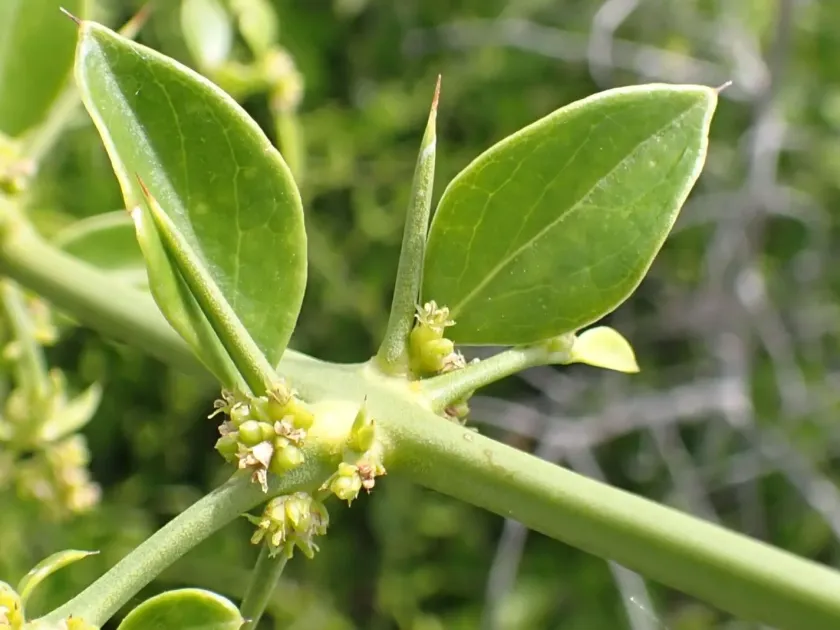
Azima tetracantha, commonly known as the needle bush, is a hardy evergreen shrub belonging to the Salvadoraceae family. It is easily recognized by its distinctive four-pronged spines located in the leaf axils, which provide an effective defense mechanism against herbivores.
This species is native to tropical regions of Africa, Madagascar, India, and Sri Lanka. It thrives in arid and semi-arid environments, often found in coastal scrublands, rocky hillsides, and sandy soils that are unsuitable for conventional agricultural crops.
The cultivation requirements are centered on high light intensity and excellent soil drainage. It is highly drought-resistant and can endure significant seasonal water shortages, making it a sustainable choice for reclamation and xeriscaping projects in arid regions.
Botanically, the plant features rigid, leathery leaves and small, yellowish-white flowers. The small, white spherical berries are a source of food for birds, which play a crucial role in the plant's propagation and seed dispersal within its natural range.
Economically, Azima tetracantha is highly valued in traditional medicine for its anti-inflammatory, diuretic, and analgesic properties. Additionally, its impenetrable thorny structure makes it an ideal choice for establishing natural protective boundaries around rural fields and livestock enclosures.
Main diseases and pests
Azima tetracantha exhibits strong natural resistance to major pests and diseases, largely due to the presence of secondary metabolites within its tissues. This inherent resilience allows it to flourish without the need for synthetic pesticides or specialized chemical treatments.
The primary threat to the health of this shrub is waterlogging. Because it is adapted to dry conditions, excessive moisture in the root zone can rapidly lead to root decay and fungal infections, which can be fatal if drainage is not improved immediately.
In humid conditions or areas with stagnant air, minor outbreaks of powdery mildew may occur on the foliage. Proper pruning and spacing are recommended to promote air circulation within the canopy and reduce the likelihood of such fungal issues.
While pests such as scale insects may occasionally infest the plant, they rarely reach levels that require control. The plant's tough, leathery leaves act as a physical barrier, deterring most common garden pests that typically affect softer vegetation.
Overall, the needle bush is a low-maintenance, robust plant that excels in harsh environments. Minimal agronomic intervention is required, provided that the soil is kept well-drained and the plant is placed in an appropriately sunny and dry location.