
Azanza lampas
Azanza lampas
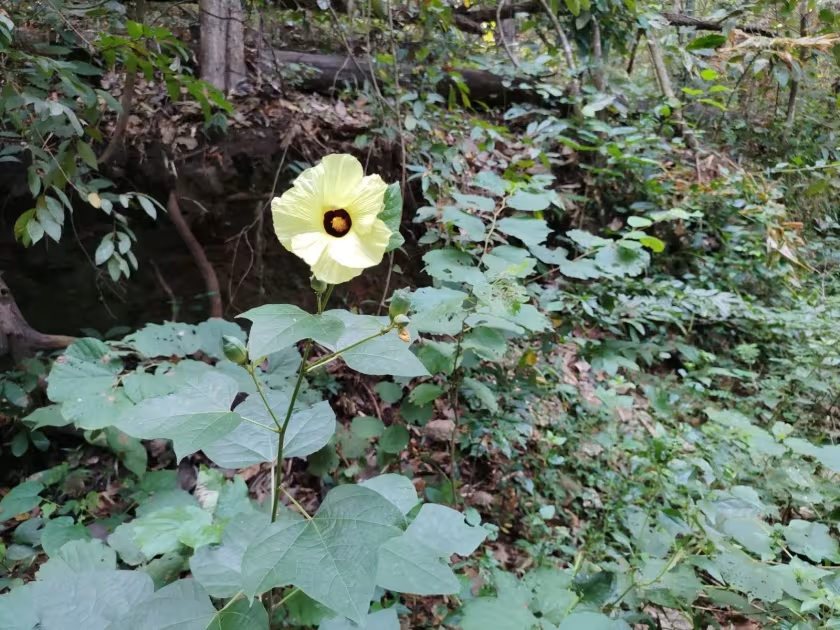
Description
Sowing dates
Azanza lampas, also known as Thespesia lampas, is a perennial shrub belonging to the Malvaceae family. In its natural habitat, it propagates primarily through seeds sown at the onset of the rainy season.
When cultivated, seeds often require scarification to enhance germination rates. They are typically sown at a depth of 2–3 cm, maintaining adequate spacing between plants to support healthy root development.
Nursery propagation followed by transplanting into the open field is a common practice to ensure better seedling survival. It is crucial to select sites with good drainage, as waterlogging is detrimental to young plants.
The temperature during the sowing period should remain consistently warm, ideally between 22–25 degrees Celsius. The crop is sensitive to thermal shocks, necessitating protection against cold snaps in early stages.
In industrial settings, seeds are collected in autumn, cleaned, and stored in cool, dry conditions. High-quality seed stock is essential for achieving uniform stand establishment and optimal yield.
Growing requirements
This plant thrives in sunny, open locations as it is a light-demanding species of tropical origin. It prefers high atmospheric humidity and is well-adapted to tropical climatic conditions.
Azanza lampas has moderate soil requirements but performs best in loamy or sandy-loam substrates with excellent aeration. The soil pH should ideally range from neutral to slightly acidic.
The shrub is highly drought-tolerant once established, yet regular irrigation is required during the active growth phase to ensure the production of high-quality fiber. Soil salinity should be avoided as it limits growth.
Organic fertilizers applied during spring are preferred. Nitrogen promotes green biomass development, while phosphorus and potassium complexes are vital for building overall plant resilience.
The native range encompasses South and Southeast Asia, including India and the Philippines. The species is highly adapted to hot environments and can withstand prolonged dry spells if the soil remains deep enough.
Yield
The primary agricultural output of Azanza lampas is the bast fiber extracted from the stem bark. This fiber is noted for its durability and is utilized in the production of ropes, twine, and rough fabrics.
Biomass yield depends heavily on planting density and the quality of agricultural management. With proper care, significant stem growth can be achieved within a single season, ready for fiber processing.
The seeds of the plant are also economically relevant, as they contain oils that may be extracted for technical or industrial applications. Oil yield serves as a secondary metric for crop productivity.
Azanza lampas flowers possess ornamental value, allowing plantations to double as a source of material for the floral or, in some regional cases, perfume industries.
Initial processing involves the retting of stems, a process where they are soaked in water to separate the useful fibers from the woody core. Proper timing of harvest is critical to prevent stem lignification.
Main diseases and pests
The plant is susceptible to various pests common to the Malvaceae family. Leaf-chewing insects and aphids that target young shoots are among the primary threats to plantation health.
Fungal diseases, including leaf spots and root rots, can occur if irrigation is mismanaged or if air circulation around the plants is poor. Regular weeding and thinning help mitigate these risks.
For large-scale pest control, the use of biological insecticides is recommended to maintain the organic integrity of the harvested fiber. Chemical pesticides should be used sparingly if at all.
Weeds compete aggressively with the shrub during its early growth stages. Mulching the soil around the base of the plants effectively suppresses weed growth and helps retain soil moisture.
Monitoring the plantation during high-humidity periods is essential, as these conditions favor the development of pathogens that may cause rot in the lower portions of the stems.
Harvesting
Harvesting for fiber is conducted once the stems have reached maximum height, but before the end of the flowering phase. This timing ensures the most flexible and durable fiber quality.
Cutting is performed either mechanically or by hand. Once harvested, the stems are bundled and placed in water bodies for retting, which allows the bark to be easily stripped from the stalks.
Seed collection is carried out as the pods mature. Timely harvesting is vital to prevent natural seed dispersal and yield loss resulting from pod dehiscence (splitting).
After retting, the fiber is thoroughly washed, air-dried, and sorted according to qualitative characteristics such as fiber length and purity levels.
Stored fiber should be kept in covered, well-ventilated structures to protect against mold growth and maintain the mechanical integrity of the strands.