
Arthrocaulon macrostachyum
Arthrocaulon macrostachyum
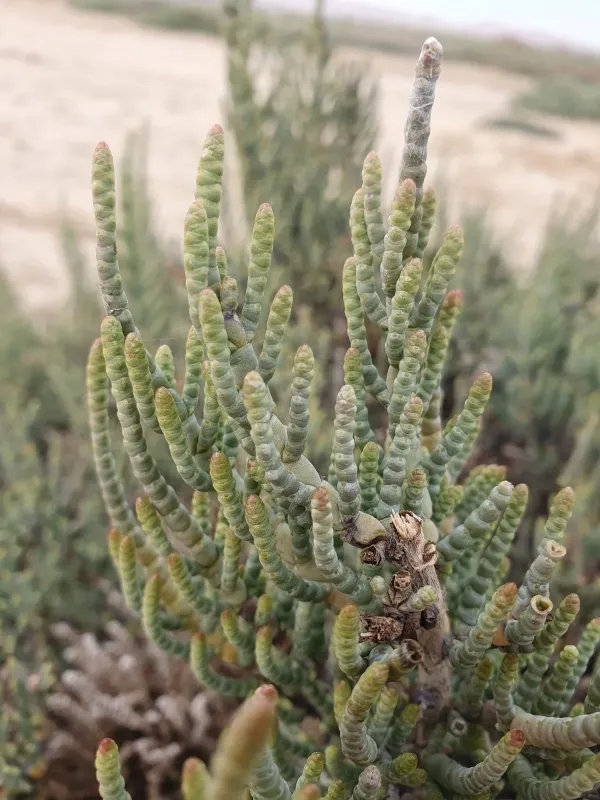
Description
Growing requirements
Arthrocaulon macrostachyum is a perennial succulent halophyte belonging to the Amaranthaceae family. It is characterized by its segmented, leafless stems which serve as water-storage organs, allowing the plant to thrive in hypersaline environments where traditional crops would fail due to osmotic stress.
The plant originates from coastal salt marshes and inland saline depressions across the Mediterranean basin and North Africa. It is a strictly salt-dependent species that requires specific concentrations of sodium chloride in the soil to maintain normal physiological functions and growth rates.
Optimal cultivation requires highly alkaline and saline soil conditions. Unlike typical crops, Arthrocaulon macrostachyum does not require freshwater irrigation and can utilize brackish or seawater, making it a sustainable choice for irrigation-scarce regions facing soil salinization.
The agronomic profile includes high solar radiation requirements. It is best suited for regions with high evaporation rates and arid climates, where it can act as a bio-filter to reduce soil salinity levels over subsequent growing cycles.
Commercial potential focuses on phytoremediation of damaged lands and potentially as a source of biomass. The plant is valued for its role in preventing soil erosion in harsh coastal zones while simultaneously maintaining high levels of biological productivity in otherwise barren landscapes.