
Anomochloa marantoidea
Anomochloa marantoidea
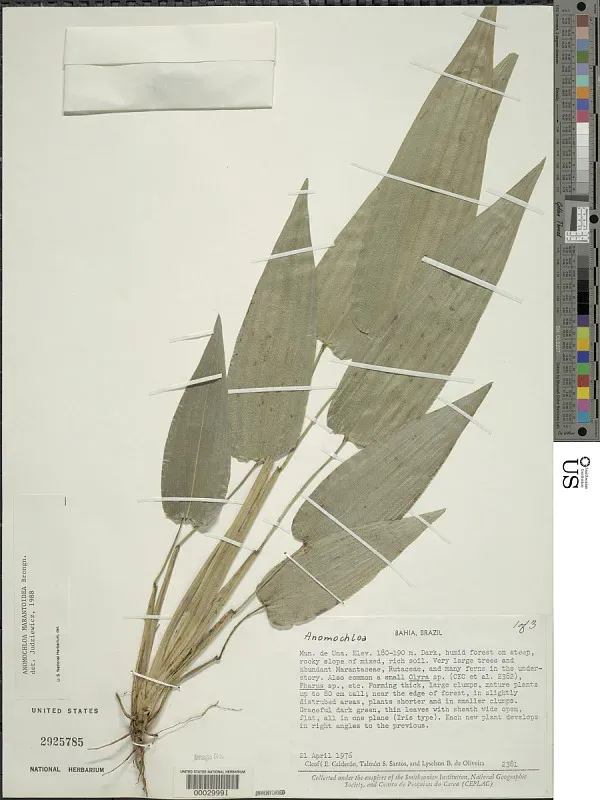
Description
Growing requirements
Anomochloa marantoidea is a fascinating member of the Poaceae family, distinguished by its unique morphology that sets it apart from typical grasses. It is native to the Atlantic forest region of Bahia, Brazil, where it thrives in shaded and humid environments.
The plant is known for its broad, petiolate leaves which resemble those of the Marantaceae family, explaining its specific epithet. This structural adaptation allows the plant to maximize light absorption in the understory of dense tropical forests.
Regarding environmental needs, this species requires high humidity levels and constant tropical temperatures. It is extremely sensitive to cold snaps and drought, making it unsuitable for standard agricultural practices in temperate climates.
Cultivation practices in controlled environments involve using well-draining, humus-rich soil mixes. Consistent moisture is critical, but the soil must remain aerated to prevent root pathogens, which the plant is highly susceptible to in captivity.
Currently, the economic or agricultural utility of Anomochloa marantoidea is negligible as it is not a food or fiber crop. Its primary value remains strictly within botanical science, germplasm conservation, and specialized horticultural collections that focus on rare tropical flora.