
Yellow mistletoe
Alepis flavida
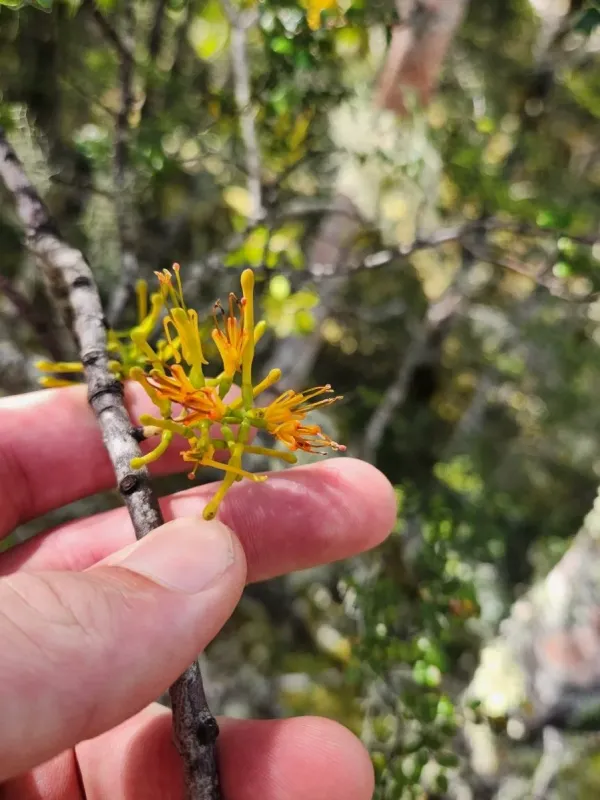
Description
Growing requirements
Alepis flavida, commonly known as yellow mistletoe, is a member of the Loranthaceae family. This species is a hemiparasitic shrub that relies on host trees to survive, attaching itself to branches and drawing water and nutrients through specialized structures called haustoria.
The plant is endemic to New Zealand, primarily found in montane forests. Its survival is deeply tied to the presence of host trees, particularly Nothofagus species, which provide the structural and chemical support required for the mistletoe's development.
Botanically, it is characterized by succulent leaves and striking yellow-to-orange flowers. Unlike traditional agricultural crops, it does not require soil cultivation, but it requires a very specific microclimate with consistent humidity and adequate sunlight exposure.
Requirements for its growth include a healthy host tree population. The plant's physiology is adapted to the nutrient flow within the host's xylem, meaning it cannot survive independently or be farmed in standard agricultural conditions.
Its хозяйственное use is strictly ecological. It serves as an essential food source for native honey-eating birds, playing a vital role in maintaining the avian biodiversity within the pristine forests where it grows.
Main diseases and pests
The primary threat to Alepis flavida is the predation by introduced mammalian species, such as possums. These animals consume the foliage, buds, and flowers, often killing the mistletoe plants and preventing them from reaching maturity or reproducing.
Habitat loss and deforestation are significant dangers. The reduction of mature beech forests directly decreases the number of available host trees, which restricts the potential range for new mistletoe colonization.
Diseases affecting the plant are often linked to the health of the host tree. If the tree's health declines due to fungal infection or environmental stress, the mistletoe suffers from a lack of resources, often dying alongside the host.
The decline of native bird species poses a serious threat to the plant's reproduction. As the mistletoe relies on specific birds to distribute its sticky seeds, a decrease in bird populations leads to a failure in the recruitment of new generations.
Conservation strategies focus on the control of invasive species and the protection of old-growth forest habitats. Active monitoring of host tree health is also necessary to ensure the long-term survival of the Alepis flavida populations.