
Agrostistachys borneensis
Agrostistachys borneensis
Description
Growing requirements
Agrostistachys borneensis is a member of the Euphorbiaceae family, representing a group of tropical shrubs native to the dense, humid rainforests of Borneo. It is a perennial species adapted to the consistent warmth and high humidity of equatorial zones.
The cultivation requirements for this species focus on replicating its natural tropical environment. It thrives in ambient temperatures between 24°C and 30°C, and requires high atmospheric humidity to maintain the turgor pressure of its distinctive foliage.
Soil management for this plant involves using a porous, nutrient-rich substrate that provides excellent drainage while retaining consistent moisture. It is crucial to prevent both waterlogging and complete drying of the root zone, as the plant is highly sensitive to irrigation fluctuations.
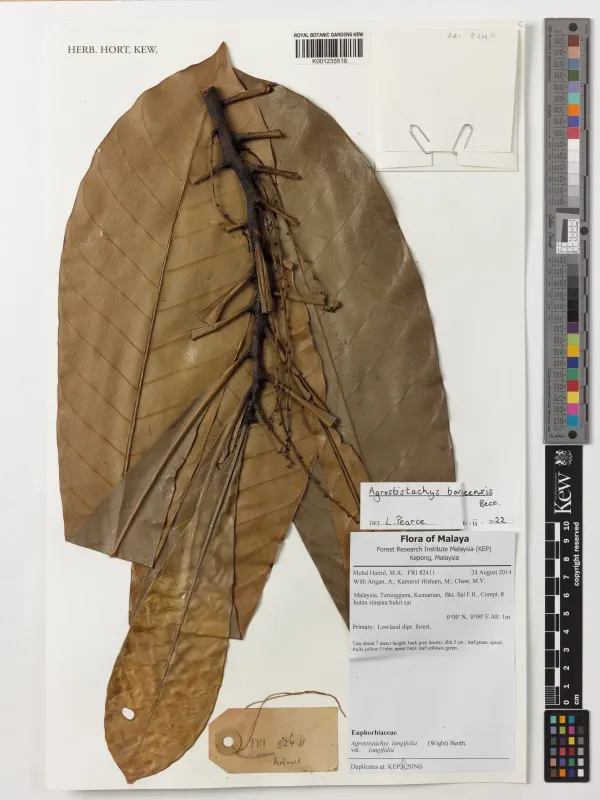
Botanically, the plant is characterized by its stiff, lanceolate leaves arranged in a spiral pattern along woody stems. The growth habit is generally slow, emphasizing the development of a robust root system before significant vegetative mass is achieved in the upper canopy.
The economic and research interest in this species lies in its potential for botanical education and specialized conservatory displays. Its unique morphology provides insights into the evolutionary adaptations of plants living under the canopy of tropical Southeast Asian forests.
Main diseases and pests
The most significant threats to Agrostistachys borneensis include fungal root infections such as Phytophthora or Pythium, which typically manifest when the soil remains too wet for extended periods. Proper drainage and aeration are essential preventative measures against these pathogens.
Common pests associated with this plant in cultivation are spider mites and scale insects. These pests are particularly prevalent in indoor or greenhouse settings with low air circulation and low humidity levels. Regular inspection and maintaining an appropriate microclimate are key to effective control.