
How to Make Soil Fertile – Soil Improvers
Soil improvers are often confused with fertilizers, but they serve different purposes. Fertilizers feed the plant. Soil improvers work with the soil itself: they make it loose, breathable, and able to retain moisture and nutrients. They do not contain nitrogen, phosphorus, or potassium in the amounts normally associated with plant feeding. Yet without them, even the highest-quality organic matter will only work at half strength.
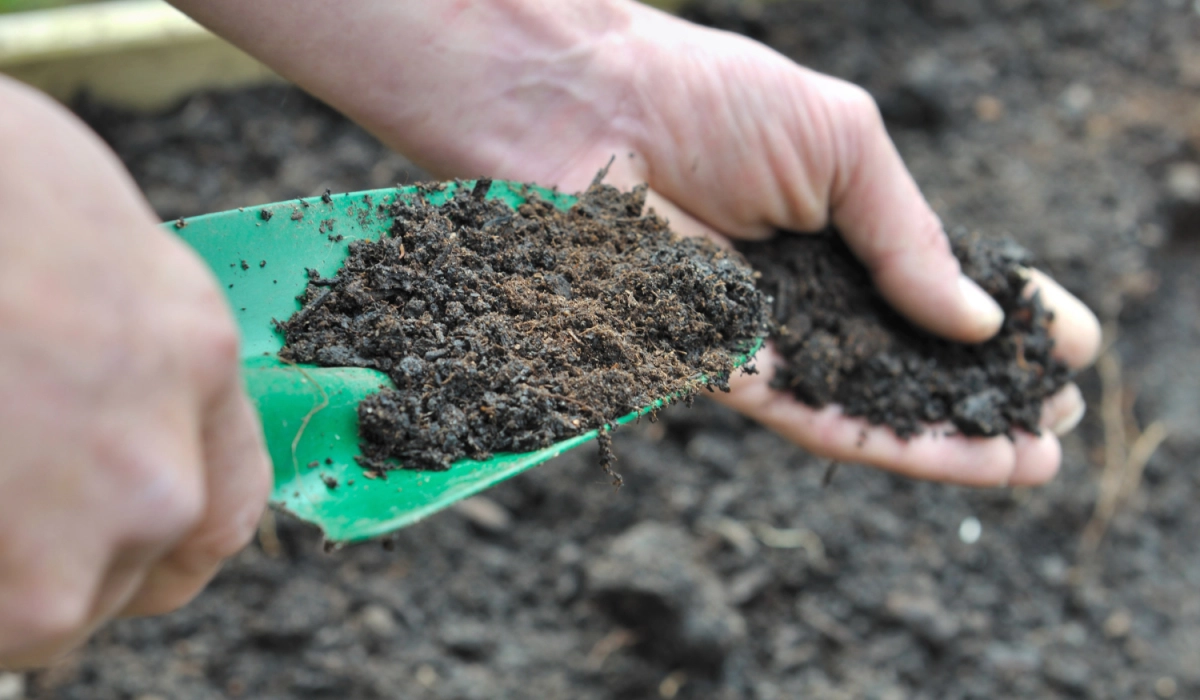
Soil improvers are often confused with fertilizers, but they serve different purposes. Fertilizers feed the plant. Soil improvers work with the soil itself: they make it loose, breathable, and capable of retaining moisture and nutrients. They do not contain nitrogen, phosphorus, or potassium in the amounts normally associated with feeding. Yet without them, even the highest-quality organic matter will only work at half strength.
Clay is too dense — roots suffocate in it, water stagnates, and beneficial bacteria do not survive. Sand, on the other hand, is too loose: moisture and nutrients disappear instantly, and organic matter breaks down faster than it can provide benefits. Acidic peat soil prevents plants from absorbing elements no matter how much fertilizer you apply. Different problems, but the solution is the same: you need to work on the soil structure. Without this, any fertilizers will only work at half strength.

How to Choose Soil Improvers
For heavy clay soils, loosening agents are needed: perlite, vermiculite, and fine expanded clay. They create air pockets where roots can breathe and beneficial bacteria can live.
For light sandy soils, moisture-retaining components are needed: peat, coconut substrate, and vermicompost. They prevent water from disappearing instantly and create a reserve of nutrients.
For acidic soils — deacidifying agents: dolomite flour, lime, and ash. They normalize pH, and plants begin to absorb what was previously unavailable.
For all soils, long-acting organic materials are useful: compost, humus, and vermicompost. They not only improve structure but also feed the microflora, which in turn supports the roots.
To restore biological activity, biological products with live bacteria and fungi are needed. Without them, even the best organic matter will decompose too slowly.
Some products combine several functions. For example, Organic Mix soil improvers are compositions based on oilseed press cake. They simultaneously loosen the soil, suppress pathogenic microflora, and provide gentle nutrition.
How to Understand What Your Soil Needs
The most accurate method is laboratory analysis. But usually, we rely on visible signs.
-
Take a handful of moist soil and try to roll it into a sausage shape. If it rolls easily and does not crack, the soil is heavy and needs loosening agents. If it crumbles, it is light and sandy and needs moisture-retaining components.
-
Look at the weeds. A lot of horsetail, sorrel, and plantain means the soil is acidic. Lamb’s quarters, nettle, and bindweed grow on neutral and slightly alkaline soils. Vinegar or baking soda can also help indicate acidity.
-
Assess how quickly the soil dries out after watering and how long it retains moisture. This will give an idea of its structure.
How to Apply Soil Improvers
They are best applied during digging or planting, spreading them evenly over the surface and incorporating them into the top layer. The effect builds up gradually. You cannot turn heavy clay into black soil in one season, but after 2-3 years of regular work, the structure changes dramatically.
It is important not to overdo it. Excess sand in clay creates a concrete-like effect. Too much peat increases acidity. Deacidifying agents also work in measured amounts — it is better to do an analysis and apply exactly as much as needed.
And one more point: soil improvers do not replace fertilizers. They create the conditions in which fertilizers begin to work. If you have good structure, living microflora, and normal pH, even simple feeding gives excellent results.
Good soil is the main resource. It does not require constant input, gets sick less often, and forgives care mistakes. Plants in it are stronger, yields are more stable, and working with such soil is a real pleasure.
Try setting aside one bed this season and working on its structure. The result will most likely surprise you. And then you will no longer look at your plot as just a place where something has to be planted. You will begin to see it as a living organism that can and should be treated, fed, and protected.